
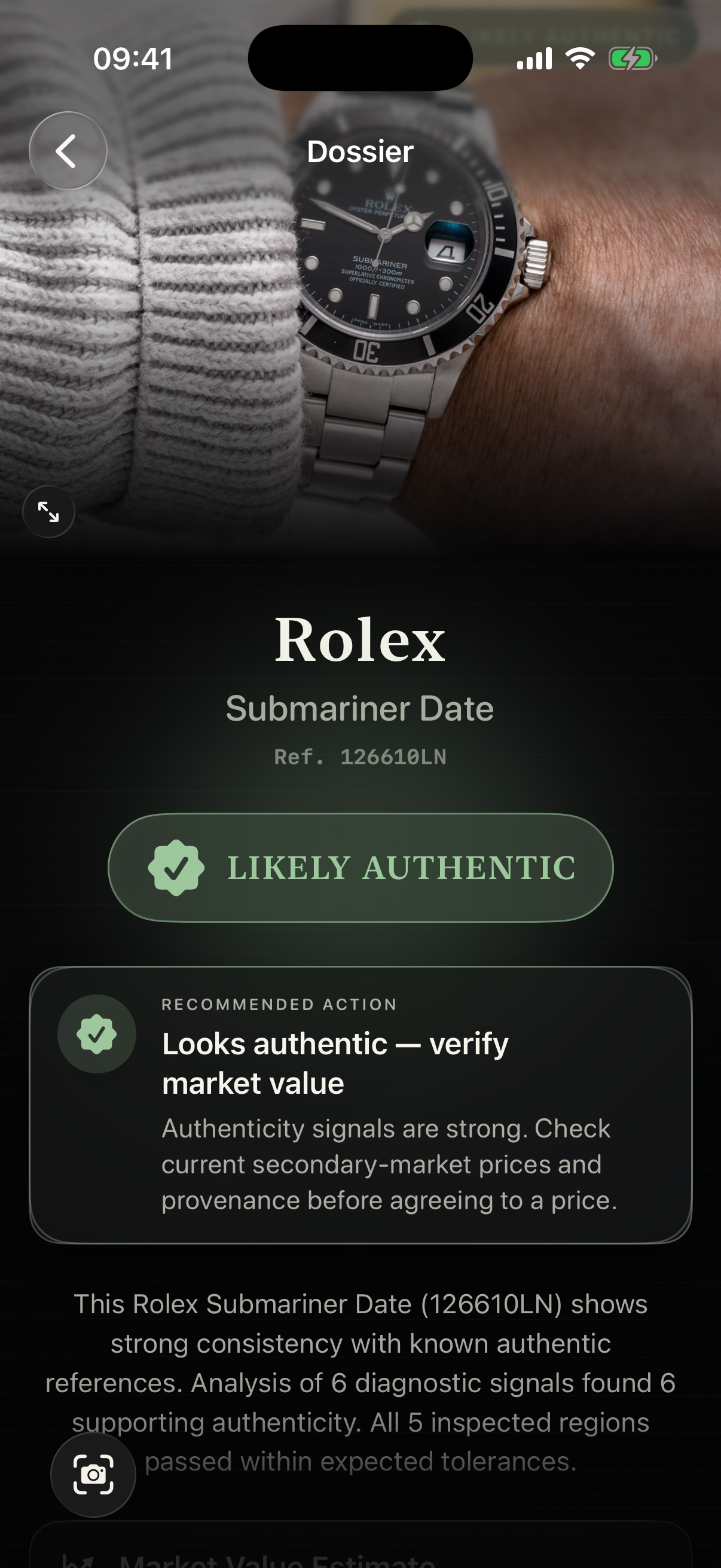
Why Rolex is the most-faked watch — and the easiest to catch
Rolex sells roughly one million watches a year. Estimates of counterfeit volume run higher than that. The brand has standardised its production for decades — same case proportions, same dial layouts, same crown logo, same 31-character rehaut engraving — which is exactly why fakes keep failing the same checks. A counterfeit Submariner has to nail every one of those checks simultaneously. WatchRadar grades them one by one.
The eight tells the AI grades on every Rolex
1. Cyclops magnification
A genuine Rolex cyclops lens magnifies the date by 2.5×. Counterfeit lenses typically run between 1.5× and 2.0× — visibly weaker. WatchRadar measures the height of the date numerals through the lens and compares against the un-magnified expected value for the reference.
2. Rehaut engraving
Modern Rolex models laser-etch "ROLEXROLEXROLEX" repeating around the inner bezel rim, with the watch’s serial number at 6 o’clock. The depth, kerning and break before the serial are highly consistent. Fakes either skip the rehaut entirely, paint it on, or get the kerning wrong.
3. Applied crown logo at 6 o’clock
On dial-only models (Submariner, Datejust, GMT-Master), the coronet is an applied metal element with a specific 5-point profile. Counterfeit crowns are typically printed, or applied with the wrong proportions and a flat top. WatchRadar scores logo geometry against the reference catalogue.
4. Dial typography
Rolex sets dial text in a proprietary typeface with characteristically rounded "C" and "O" shapes and a wide-eared "R". The depth of letters above the printed surface, the kerning and the alignment of "300m=1000ft" or "Superlative Chronometer Officially Certified" are all repeatable. Misalignments are some of the most common fake-tells.
5. Bezel insert and pearl
The Cerachrom (ceramic) bezel of modern sport models is platinum-electroplated for the numerals — and they sit perfectly flush. The bezel pearl is a luminous dot under sapphire. Counterfeit pearls sit proud of the bezel surface, are not perfectly round, or use the wrong lume colour.
6. Bracelet end-links and clasp
Rolex Oyster bracelets use solid end-links flush to the case with no gap. The clasp has a glide-lock or easy-link extension stamped to a known precision. Fake bracelets typically rattle, leave a gap at the lugs, or use stamped end-links that look slightly bent. WatchRadar checks the lug-to-bracelet seam.
7. Case finishing transitions
Rolex Oyster cases have a brushed top to the lugs and polished sides, with a sharp, clean transition between the two. Fakes commonly blur the transition or polish the entire case. The Submariner’s crown guards have a specific contour that counterfeits often round off too much.
8. Serial and reference cross-check
WatchRadar reads the engraved reference number on the rehaut at 12 o’clock and the serial at 6 o’clock with OCR, then cross-checks them against the format expected for that production year. A 2024 Submariner with a 2010-format serial is suspicious; a serial whose check-digit doesn’t match is more so.
Crystal, caseback and papers — the four tells nobody photographs
The eight checks above cover the parts of a Rolex a seller will happily photograph. Four more sit just outside the usual listing photos, and they are where careless counterfeits still lose.
- The laser-etched crown (LEC). Since roughly 2002 Rolex has etched a microscopic coronet into the sapphire at 6 o’clock. It is invisible head-on and appears only when light rakes across the crystal at a shallow angle. Fakes either omit it, etch it too deep (visible from any angle), or place it slightly off the 6 o’clock axis. WatchRadar prompts for the raking-light angle during the dial capture and scores the coronet position, not just its presence.
- The caseback. Every modern Rolex except the Cellini Prince has a closed, unsigned caseback — no display window, no model engraving, no "Rolex Oyster Perpetual" ring text. A Submariner with a glass back or an engraved caseback is not a Rolex with an aftermarket part; it is a fake. Aftermarket engraved casebacks do exist on genuine watches as owner customisation, and WatchRadar flags them as a provenance note rather than a verdict failure.
- Bracelet and clasp codes. Rolex stamps a bracelet reference and a clasp code inside the clasp cover. The pairing is reference-and-era specific: a 126610LN on a bracelet whose clasp code predates the model’s launch is either a replacement bracelet or a fake. WatchRadar reads the stamps with OCR when the clasp is photographed open.
- Papers. Rolex moved from the folding paper certificate to a credit-card-format warranty card in 2006 and to a card carrying a machine-readable code in 2020. Superlative Chronometer certification tightened to −2/+2 seconds per day in 2015, with a five-year international warranty from the same year. A watch presented as new-in-2023 with a pre-2020 card format is a paperwork mismatch worth resolving before money moves.
Models WatchRadar handles best
- Submariner — 116610LN, 124060, 126610LN, 126610LV, 126613, 126618, vintage 5512/5513/16610.
- GMT-Master II — 126710BLRO ("Pepsi"), 126710BLNR ("Batman"), 116710LN, 116719BLRO.
- Datejust — 126200, 126234, 126300, 126331, 178240, 116234.
- Day-Date — 228238, 228239, 228206, 118238, 118208.
- Daytona — 116500LN, 116503, 126500LN, 126506, 116508, 116528, 6263, 6265.
- Explorer / Explorer II — 124270, 226570, 124273, 214270.
How to run the five-angle scan on a Rolex
The capture flow is the same on every watch, but what each angle has to show is brand-specific. On a Rolex, these five frames are what let the AI reach the eight checks above.
Dial, straight on, with the date under the cyclops
Square the watch to the camera so the date sits centred in its aperture. Keep the light off-axis — a specular blowout on the sapphire is the single most common reason the cyclops measurement fails. This frame carries the applied coronet, the dial typography, the datewheel font, and the 2.5× magnification measurement.
Bezel and rehaut, tilted about 20°
Tip the watch away from you until the inner bezel rim comes into view. That angle brings the laser-etched ROLEXROLEXROLEX rehaut ring and the 6 o’clock serial into the same frame as the Cerachrom numerals and the bezel pearl. Rake the light across the crystal here too so the laser-etched coronet at 6 o’clock registers.
Crown and crown guards, in profile
Shoot the 3 o’clock side flat-on at case height. The Triplock crown’s tooth profile, the coronet on the crown face, and — on a Submariner or Sea-Dweller — the crown-guard contour are all graded from this one frame. Fakes commonly round the guards too generously.
Case at 45° from above
From roughly 45°, both the brushed lug tops and the polished case flanks land in frame together. The tell is the sharpness of the line where they meet: on a genuine Oyster case it is a clean edge, on most counterfeits it is a blur, and on an over-polished genuine watch it is soft but continuous.
Bracelet, clasp open, end-links visible
Lay the bracelet flat with the clasp cover open. This captures the Glidelock or Easylink stamping, the bracelet and clasp codes, and the seam where the solid end-links meet the case — which should show no gap at all.
Where WatchRadar earns its keep on a Rolex
A counterfeit Submariner that survived a glance from across the room can fail on three of the eight tells above before you finish reading this sentence. WatchRadar standardises the checks: it does not get tired on the fortieth photo, it does not miss the rehaut because the lighting was poor, and it gives every region a confidence score so you know which tells are weak — not just whether the watch is good. Pair this with a price-fairness check (the dossier estimates current market value) and you have most of what a pre-purchase inspection delivers, on iPhone, in two minutes.
Other brand guides
- Authenticating an Audemars Piguet Royal Oak — tapisserie depth, bezel-screw rotation and the H-link knife-edge.
- Authenticating a Patek Philippe Nautilus — embossed dial pattern, Calatrava cross proportions and lug-side reference engraving.
- Authenticating an Omega Speedmaster or Seamaster — tachymeter alignment, helium escape valve and the METAS Master Chronometer marking.
- Authenticating a Cartier Tank or Santos — cabochon crown stone, blued sword hands and the Cartier secret signature.
- Authenticating a Jaeger-LeCoultre Reverso — swivel-cradle engraving depth, rivet flushness and bridge anglage.
- Or start at the brand authentication hub for how the AI weights each brand differently.
Reading this before a specific kind of Rolex deal?
- Buying from a private seller or a Chrono24 listing — the pre-purchase inspection walkthrough for buyers covers what to request before you send money.
- Selling or brokering — the verification pipeline for resellers shows how a certificate per watch shortens the negotiation.
- Cataloguing what you already own — the private watch box for collectors keeps a dated dossier and valuation per reference.
- Weighing a service against an app — WatchRadar vs Entrupy is an honest split of what each can and cannot do.