
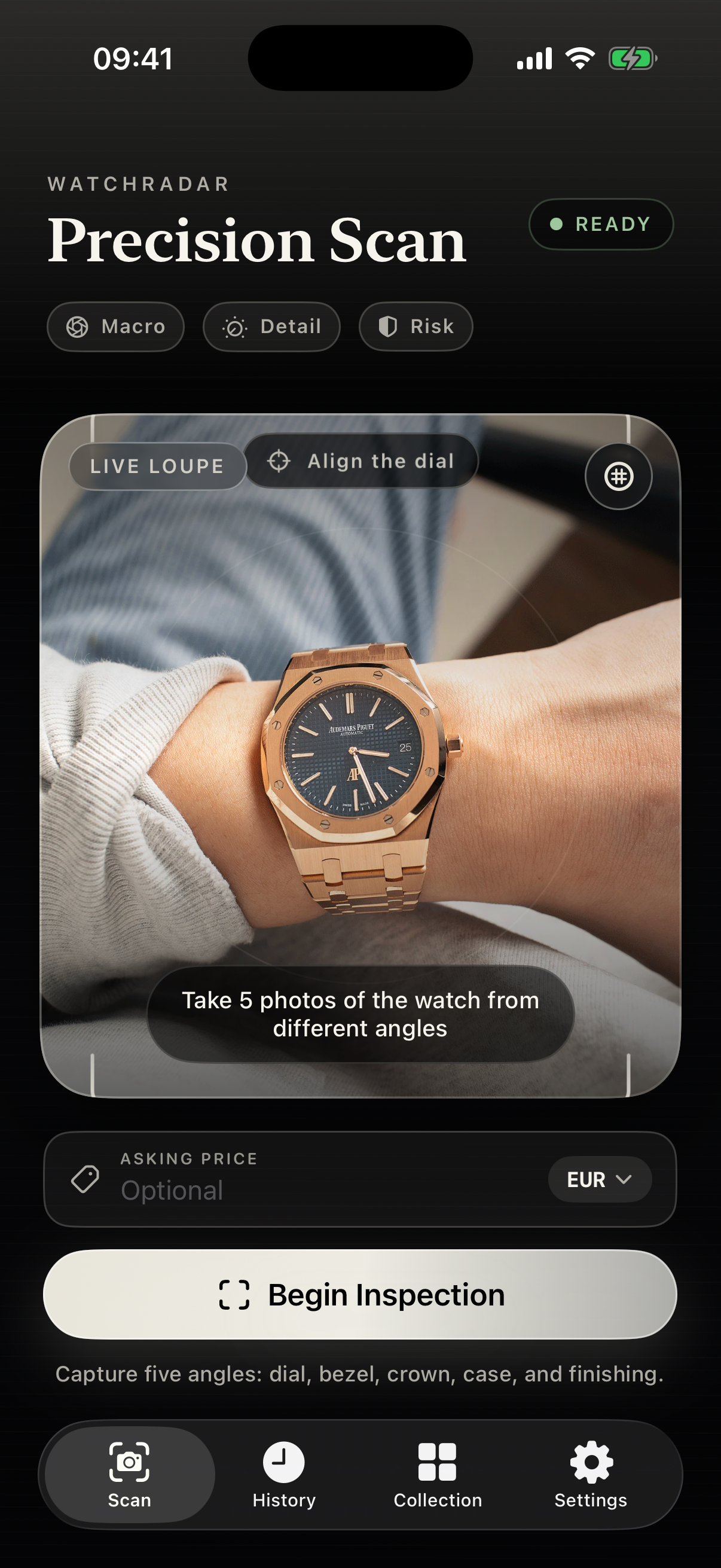
What makes a Royal Oak hard to fake
AP’s defining design — Gérald Genta, 1972 — is built around tolerances counterfeiters struggle to hold. The integrated bracelet meets the case at the perfect lug-less angle on a real Royal Oak; on most fakes there is a faint visible step. The octagonal bezel is held on by eight white-gold screws aligned at exactly the same rotation; on fakes the screw heads are rarely all parallel. The tapisserie is hand-engraved on a guilloché machine; printed or stamped imitations have soft corners and uneven depth. WatchRadar grades each of these.
The seven tells the AI grades on every Audemars Piguet
1. Tapisserie pattern depth
Petite Tapisserie (15202) and Grande Tapisserie (15500, 15400, 26331) have specific square sizes and a distinct chamfer at every intersection. Counterfeits typically print the pattern or stamp it shallow — the corners look soft and the reflection across the dial is uneven.
2. Bezel screw alignment
The eight bezel screws on a Royal Oak are precisely oriented — not random. WatchRadar measures the rotation of each screw slot relative to the bezel centre. Misaligned screws are a classic fake-tell.
3. Applied AP logo
The "AP" logo at 6 o’clock (or 12 on some models) is an applied white-gold or rose-gold mark with a specific letter geometry. Counterfeit logos are commonly printed, slightly off-centre, or use the wrong stem-width on the "P".
4. Hour-marker faceting
Royal Oak hour markers are applied, double-faceted batons with crisp edges and uniform luminous fill. The "12 o’clock" marker has a different geometry on some references. Fake markers are often single-faceted or printed.
5. Bracelet H-link transitions
The bracelet alternates polished H-links with brushed flat links. The transition between finishes is a knife-edge on a real AP. On fakes, the polishing bleeds slightly into the brushed surface or the H-link corners are rounded.
6. Case finishing — chamfer and bevel
The Royal Oak case has a polished chamfer running the length of the lugs, hand-applied. WatchRadar checks the chamfer continuity and the angle. Counterfeit cases either skip the chamfer entirely or apply it inconsistently.
7. Movement signature on display backs
Many modern AP references have a sapphire case-back exposing the calibre 3120, 3126, or 4302 movement. The rotor is engraved with "AUDEMARS PIGUET" in a specific font; the gold weight is hallmarked. WatchRadar reads the rotor engraving with OCR through the sapphire.
Caseback, rotor and papers — what the dial photos never show
A Royal Oak listing will always show the dial and the bracelet. The evidence that separates a very good fake from a real one is mostly on the other side of the watch.
- The caseback rim engraving. Most modern Royal Oak references carry a sapphire caseback with the reference number and an individual case number cut into the surrounding steel or gold rim. The cuts are deep and square-shouldered; counterfeits tend to be shallow, laser-greyed rather than cut, and often reuse one case number across a production batch. WatchRadar reads both with OCR and flags a reference/case-number pairing that does not belong to the same era.
- The rotor and calibre generation. Through the sapphire you should see the correct movement for the reference — broadly, calibre 3120 on the 15400-era Selfwinding, calibre 4302 on the 15500 and the current Royal Oak Selfwinding, and calibre 2121 on the outgoing 15202 Jumbo. A 41 mm Selfwinding fitted with the wrong rotor geometry for its reference is a hard fail, not a service quirk.
- Gold hallmarks. On rose-gold, yellow-gold and white-gold references, the case and the bracelet both carry assay marks. A gold-coloured Royal Oak with an unmarked bracelet is either plated or a fake, and the plating usually shows first at the H-link edges where wear concentrates.
- Papers and the archive extract. Audemars Piguet issues a warranty booklet stamped by the selling boutique, and will supply an extract from its archives for older references. For a five-figure Royal Oak on the secondary market, the extract is the strongest paper evidence available and WatchRadar surfaces a prompt to request it rather than pretending the scan substitutes for it.
Models WatchRadar handles best
- Royal Oak Jumbo Extra-thin — 15202ST, 15202OR, 15202BC, 15202IP.
- Royal Oak Selfwinding — 15400, 15500, 15510, 15550, 26331, 26315.
- Royal Oak Chronograph — 26315ST, 26331ST, 26331OR, 26240, 26239.
- Royal Oak Offshore — 26470, 26480, 26420, 25721 ("Beast"), 26233.
- Code 11.59 — 15210, 26393, 26394, 26395.
How to run the five-angle scan on a Royal Oak
The Royal Oak rewards a different capture discipline than a round sport watch: almost everything that matters is a surface-finish tell, and surface finish only reads correctly under raking light.
Dial, straight on, light raking from one side
Square the dial to the camera but put your light source low and to one side. Flat frontal light hides tapisserie depth completely — a printed dial and a guilloché dial look identical head-on under a ring light. Raking light throws a shadow into every square, which is exactly what the depth measurement needs.
Bezel and the eight screws, from directly above
Shoot the bezel flat from overhead so all eight screw heads are in one plane. WatchRadar measures each slot’s rotation relative to the bezel centre; a perspective-skewed frame makes that measurement unreliable. Keep the whole octagon in frame — the chamfer on each of the eight flats is graded here too.
Crown and case flank, in profile
Flat-on at case height from the 3 o’clock side. This frame carries the crown profile, the AP logo on the crown face where the reference has one, and the continuity of the polished chamfer that runs the length of the case flank — the single hardest thing for a counterfeit case to reproduce.
Case-to-bracelet junction at 45°
Angle down onto the point where the bracelet leaves the case. A genuine Royal Oak is lug-less: the bracelet grows out of the case with no step and no gap. Nearly every counterfeit shows a faint shelf here, and this is the frame that catches it.
Bracelet flat, with the clasp open
Lay the bracelet out and open the folding clasp. The alternation of polished H-links and brushed flat links should show a knife-edge transition at every boundary, the clasp interior should be signed, and on precious-metal references the hallmarks live here.
Where WatchRadar earns its keep on a Royal Oak
The retail premium on a Royal Oak Selfwinding 15500 is roughly 3× MSRP on the secondary market. That premium is exactly why the fakes are good. The market math says: a $35,000 fake that looks correct from across the room is worth attempting. WatchRadar standardises the close-look checks so you do not have to be a Royal Oak collector to know what to inspect — and the market-value estimate flags watches that are authentic but priced 25% over the running fair-market band.
Other brand guides
- Patek Philippe: authenticating a Nautilus or Aquanaut — the closest comparison to a Royal Oak, and the embossed dial pattern is judged the same way the tapisserie is.
- Rolex: cyclops, rehaut and bracelet checks — the other end of the counterfeit-volume spectrum.
- Omega: Speedmaster and Seamaster tells — bezel-scale alignment and display-back calibre reading.
- Cartier: Santos and Tank tells — the other watch built around visible, orientation-specific case screws.
- Jaeger-LeCoultre: Reverso and Master Control tells — where hand-finishing evidence carries most of the verdict.
- The brand authentication hub explains how the AI re-weights its checks per maker.
Reading this before a specific kind of AP deal?
- About to pay a grey-market premium — the pre-purchase inspection walkthrough covers the photo set to demand first.
- Brokering Royal Oaks — the reseller verification pipeline attaches a dated dossier to each listing.
- Cataloguing a collection — the collector’s watch box tracks per-reference valuation over time.
- Deciding between hardware and an app — WatchRadar compared with Entrupy.