Collectors keep records the same way: a binder of papers, a folder of photos, a spreadsheet of purchase prices that has not been updated since 2019. WatchRadar is the same record system, kept current automatically — every watch authenticated to a known reference, valued at the current market band, with provenance attached and ready to share with insurance, an estate, or a future buyer.
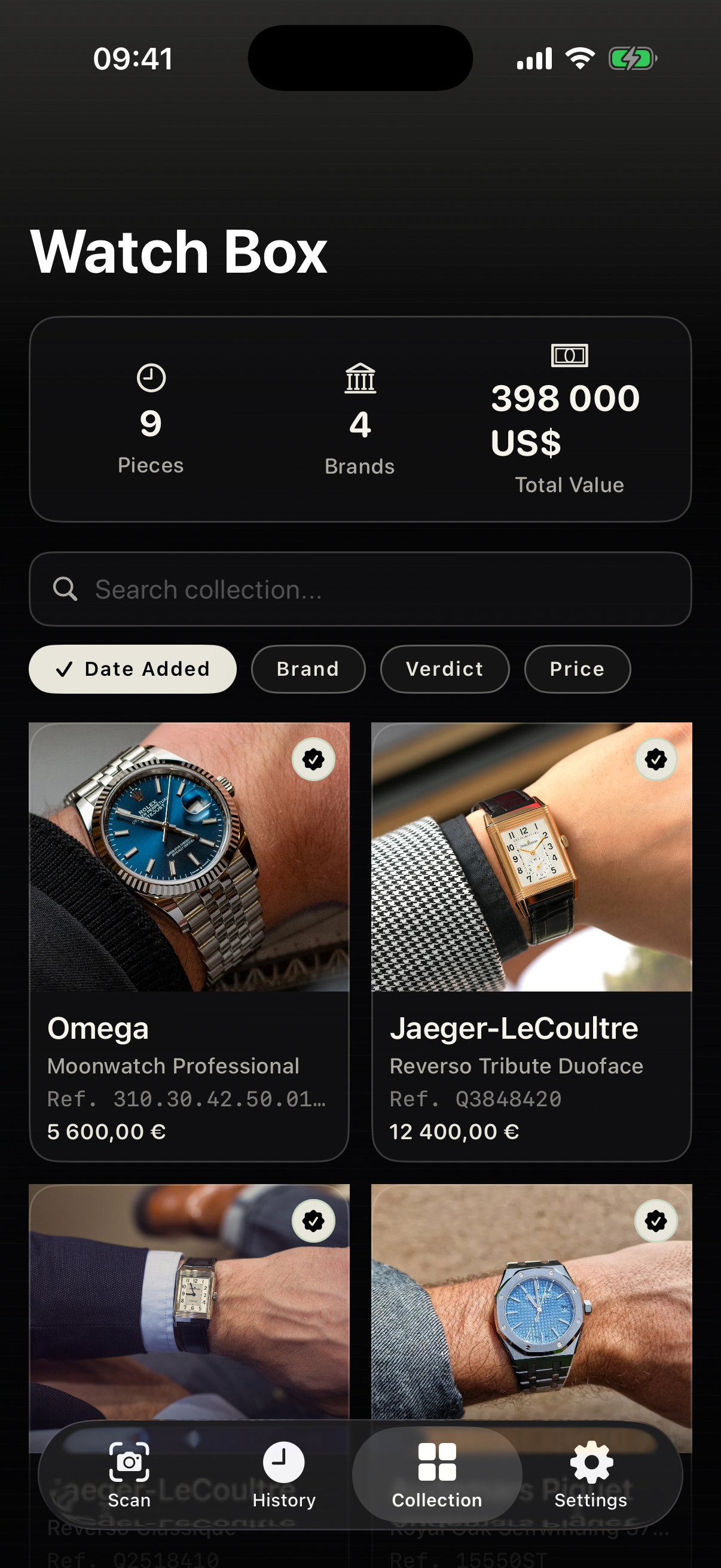
Watch Box — collection valued in real time across brands.
What a collector actually needs
Three things, almost universally: authenticity assurance for every piece in the box (so you can prove what you own), current valuation (for insurance riders, estate planning, and the inevitable "is this still worth what I paid"), and provenance retention (so the box, papers, service receipts and original retailer details do not disappear over twenty years). WatchRadar covers all three in a single place tied to the watch.
How the Watch Box works
Per watch: reference and serial captured by OCR, verdict from the five-angle scan, market-value estimate updated periodically, provenance attachments (box / papers / service receipts / original retailer card), and an optional Authenticity Certificate.
Across the collection: total value (with currency conversion), per-brand breakdown, age distribution, time-since-last-service summary, and an export ready to send to your insurance underwriter.
Privacy: the box is private by default. Certificates you choose to issue have public verification pages, but the underlying photos and provenance are never published unless you explicitly attach them to a certificate.
Insurance and estate planning
High-value watch insurance (Chubb, Hodinkee Insurance, Lloyd’s) requires a current appraisal — typically every two years for the rider to pay out at replacement value. WatchRadar generates a per-watch appraisal report with photos, reference, valuation band, and the dated dossier. The format is accepted as a supplementary appraisal document by most insurers; high-value pieces (USD 50,000+) typically still require an in-person appraisal from a qualified watchmaker, but the WatchRadar dossier covers everything below that threshold.
Service tracking
Each watch in the box has a service log. Receipts and service-centre stamps photographed and attached. The next-service estimate (typically 4–6 years for mechanical movements, 2–3 years for chronographs and complications) is surfaced as a reminder. When you sell, every piece comes with its full service history attached to the certificate.
Frequently asked questions
Can I add watches I bought decades ago?
Yes — and this is the most common entry point. Photograph each existing piece in the five required angles, run the scan, and attach whatever provenance you have (papers, receipts, service stamps). The dossier captures the current state. Older receipts and warranty cards photograph cleanly.
Does WatchRadar value pieces correctly across regions and currencies?
Market values are quoted in your local currency with the underlying market band shown in USD/EUR/CHF. Regional pricing variation (Hong Kong premium, EU VAT, US grey market) is reflected in the typical band. For especially region-specific pieces (Asia-only LEs), the valuation widens the band rather than picking a side.
What happens to my data if I stop using the app?
You can export the entire Watch Box at any time as a PDF or JSON archive. Issued certificates remain on the public verification surface unless you request takedown. The privacy policy at /privacy/ has the full retention details.
Can someone else verify a piece I own without the app?
Yes — issued Authenticity Certificates have public verification URLs. The buyer or appraiser scans the QR code on the certificate and lands on a page with the watch identification, verdict, evidence summary and issue date. The verification page does not require the WatchRadar app.
Is the Watch Box useful for collections under ten pieces?
Even for a single high-value piece, the dossier-plus-certificate workflow has value at insurance time and resale time. The brand-specific guides at /authenticate/ describe what is checked on each model. Most collectors who start with one piece add the rest of the box within the first month.