What a pre-purchase inspection actually catches
Three classes of problem, in descending order of frequency. Outright counterfeits — the easiest to catch and the most damaging if missed. Frankenwatches — authentic case with replaced dial, hands or movement; legitimately a real watch in some sense, but not the watch the seller is representing. Authentic-but-overpriced — the asking price is 25% over the running fair-market band, which makes the watch a bad purchase even though it is real.
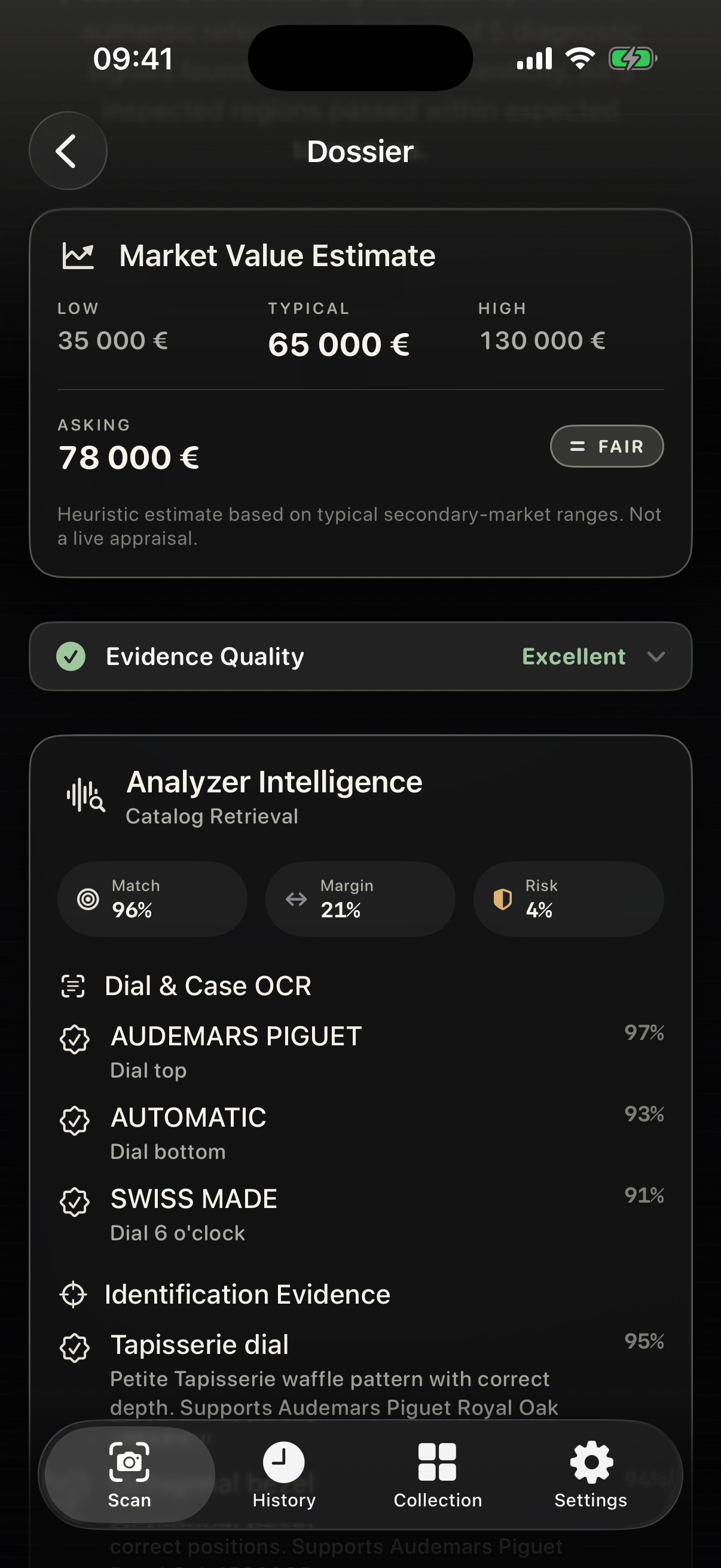
WatchRadar catches all three. The verdict (Likely Authentic / Uncertain / High Risk) addresses the first. The region-by-region inspection diagram catches the second by flagging mismatched parts. The market-value estimate addresses the third — the dossier shows the current low / typical / high band and tells you whether the asking price falls inside it.
How to use it before a purchase
- Before you go to see the watch. Ask the seller for the five required photos (or pull them from the listing if it is on Chrono24 / eBay). Run the dossier. Decide whether the in-person visit is worth the trip.
- At the seller’s. Run a fresh scan with the watch in your hand. Compare against the dossier you ran from the listing photos. Differences flag possible bait-and-switch (the watch you are now holding is not the watch in the listing).
- At the negotiation. The market-value estimate gives you a defensible counter-offer. "The fair-market band on this reference is USD 8,200–9,400 with typical at 8,800. Your asking is 9,800. Can we land at 9,000?" — backed by data, not feel.
- After the purchase. Issue an Authenticity Certificate to your own Watch Box. You now have a dated dossier of the piece at the moment you bought it — useful for insurance, useful at resale, useful if a defect surfaces in the first 30 days.
Read the brand tells before you meet the seller
A scan is far more useful when you already know what the watch is supposed to look like. Each guide below lists the specific tells the model grades for that maker, plus the frames to ask a seller for and the lighting that makes those frames usable.
- Buying a Submariner, Datejust, GMT-Master or Daytona — what to check on a Rolex, including the laser-etched crown most listings never photograph.
- Buying a Royal Oak or Code 11.59 — what to check on an Audemars Piguet, where dial lighting decides whether the scan is worth running at all.
- Buying a Nautilus, Aquanaut or Calatrava — what to check on a Patek Philippe, and why the archive extract is not optional above five figures.
- Buying a Speedmaster or Seamaster — what to check on an Omega, including the caseback-to-reference match that fails fastest.
- Buying a Tank, Santos or Ballon Bleu — what to check on a Cartier, starting with the cabochon crown stone.
- Buying a Reverso or Master Control — what to check on a Jaeger-LeCoultre, where the cradle engraving ends most counterfeits.
- Buying something else — the brand authentication hub explains how the checks are weighted for makers without a dedicated guide.
High-value purchases: what WatchRadar will not do
For a watch over USD 15,000, the dossier is one of three steps you should take. The other two: an in-person inspection (handle the watch, work the crown, listen to the rotor), and a movement inspection by a qualified watchmaker (open the case-back, inspect the calibre engravings and finishing). Together those three steps cost about USD 200 and an afternoon, on a watch where you are about to spend the price of a small car. The dossier is the cheapest of the three and the only one that scales — but for the top of the market, all three are appropriate.