
Cartier’s defence is design coherence
Cartier’s case shapes — the Tank’s rectangle, the Santos’ rounded square with exposed screws, the Ballon Bleu’s domed crown, the Panthère’s integrated bracelet — are protected by trademark and by execution. A square Tank case is easy to fake; a Tank with the right proportions, the right blued steel hands and the right cabochon-set crown is harder. WatchRadar grades the proportions and the crown-stone seating directly.
The seven tells the AI grades on every Cartier
1. Cabochon crown and stone
Most Cartier crowns are set with a synthetic sapphire (cabochon-cut) or, on precious-metal references, a true sapphire. The stone sits in a beaded crown surround with specific tooth count. Counterfeit crowns are commonly plastic, mis-coloured, or set in a flat-toothed surround.
2. Roman numeral typography
Cartier dials use a unique Roman-numeral typeface — the "X" has a slightly tapered upper terminal, the "VII" baseline alignment is intentional. The "Cartier secret signature" hides a tiny "Cartier" inside the "VII" or "X" on Tank, Santos and Ballon Bleu dials. WatchRadar flags missing secret signatures and incorrect numeral kerning.
3. Blued-steel sword hands
The hour and minute hands are heat-blued steel with a specific colour curve from royal blue (centre) to slightly darker (tip). Counterfeit hands are commonly painted blue — the colour reads flat under angled light. The seconds hand on chronographs is typically also blued.
4. Exposed screws (Santos)
The Santos’ bezel screws are slotted in a specific orientation. Modern QuickSwitch Santos models have additional bracelet-release screws. WatchRadar checks the screw count, slot orientation, and the chamfer at each screw head.
5. Engraved buckle and case-back
The deployant buckle is engraved with "CARTIER" in a specific font with a registered ® mark. The case-back has the reference and serial engraved (not stamped). WatchRadar reads both with OCR and cross-checks the format against the production year.
6. Dial finish — guilloché on precious-metal models
White-gold and rose-gold Tanks, Santos and Ballon Bleus often have a guilloché dial pattern (radiating, sunburst, or grain d’orge). The pattern depth and centre alignment are specific. Counterfeit guilloché is typically printed and reads flat.
7. Movement signature on display backs
Modern Cartier movements (1847 MC, 1904 MC, 9466 MC, 1521 MC) are signed with the manufacturer engraving and Geneva striping (Côtes de Genève). WatchRadar reads the rotor engraving with OCR through the sapphire on display-back references.
Caseback, hallmarks and papers — the Cartier paper trail
Cartier is a jeweller that makes watches, and its authentication evidence reflects that: the metal itself carries as much information as the movement does.
- Assay marks on precious metal. Gold and platinum Cartier cases and bracelets carry assay and fineness marks. A gold-coloured Tank or Santos with an unmarked case or an unmarked bracelet is plated, a fake, or both — and plating gives itself away first at the bracelet-link edges and the buckle tongue, where wear concentrates. WatchRadar prompts for a close frame of the buckle and the case flank so the marks land in the capture.
- Caseback engraving, not stamping. Cartier cuts the reference and serial into the caseback. The cuts have square shoulders and a consistent depth; counterfeits are usually laser-greyed, shallow, or set in the wrong typeface. On screwed-back Santos references, the caseback screws should be slotted in a consistent orientation like the bezel screws.
- The QuickSwitch and SmartLink era. From the 2018 Santos redesign onward, Cartier fitted a tool-free strap-change mechanism and micro-adjustable links. A watch presented as a current-generation Santos that lacks them is an earlier reference being mis-described — a pricing problem the dossier surfaces even when the watch itself is genuine.
- Papers, and Cartier’s own pre-owned channel. Original Cartier papers, the presentation box and the pouch materially raise resale value on Tank and Santos models. Cartier also sells authenticated pre-owned watches through its own channel, and a watch that came through it should have the accompanying documentation. Attach photographs of whatever paperwork exists to the Provenance Vault so the certificate records it.
References WatchRadar handles best
- Santos de Cartier — WSSA0009, WSSA0010, WSSA0018, W2SA0006, WGSA0019.
- Tank Louis Cartier — WGTA0011, WGTA0067, WSTA0042, W6800251.
- Tank Must / Tank Française — WSTA0041, WSTA0052, W51008Q3.
- Ballon Bleu — WGBB0046, W6920002, WJBB0042, W2BB0019.
- Panthère de Cartier — W25052P9, W2PN0006, WJPN0008.
- Pasha — WGPA0007, WSPA0010, WSPA0013.
How to run the five-angle scan on a Cartier
Cartier is the one brand where two of the five frames are macro frames. The secret signature and the cabochon stone are small, and both need to be genuinely in focus.
Dial, straight on, close enough to resolve the numerals
Square the dial and fill the frame with it. This capture carries the Roman-numeral typeface, the numeral kerning, the railroad minute track and — on Tank, Santos and Ballon Bleu references that have it — the secret signature hidden inside the VII or the X. If the numerals are soft in the preview, move closer rather than zooming.
Bezel and case screws, from directly above
On a Santos, shoot the bezel flat from overhead so all the exposed screws sit in one plane and their slot orientation can be measured. On a Tank or Ballon Bleu this frame instead captures the case-flank brancards and, on precious-metal references, the guilloché dial pattern under raking light.
Crown and cabochon stone, macro, in profile
Get close to the crown from the side. The cabochon should be a domed, translucent stone seated in a beaded surround with a consistent tooth count. Plastic imitations read flat and slightly cloudy, and the surround teeth are usually squared off rather than beaded. This is the most diagnostic single frame on most Cartier references.
Caseback square-on, then the hands under angled light
Shoot the caseback flat for the reference and serial cuts and the screw orientation. Then tilt the watch under an angled light so the blued steel hands show their colour gradient: heat-blued steel shifts from royal blue at the boss toward a darker tip, while painted hands stay uniformly flat.
Bracelet or strap and buckle, flat
Lay the bracelet out, or the strap with the deployant buckle visible. The buckle engraving should read CARTIER with the registered mark in the correct typeface, and on precious-metal references the hallmarks are here. On a Panthère, the link-to-link play is checked in this frame too.
Other brand guides
- Jaeger-LeCoultre: Reverso and Master Control tells — the other maker where blued hands and hand-finishing carry the verdict.
- Omega: Speedmaster and Seamaster tells — display-back calibre reading and bezel-scale alignment.
- Rolex: cyclops, rehaut and bracelet checks.
- Audemars Piguet: Royal Oak screws and tapisserie — the other watch defined by visible, orientation-specific screws.
- Patek Philippe: Nautilus and Calatrava tells.
- The brand authentication hub explains the per-maker weighting.
Reading this before a specific kind of Cartier deal?
- Buying a Tank as a gift or a first luxury watch — the pre-purchase inspection walkthrough.
- Selling jewellery-adjacent stock — the reseller verification pipeline.
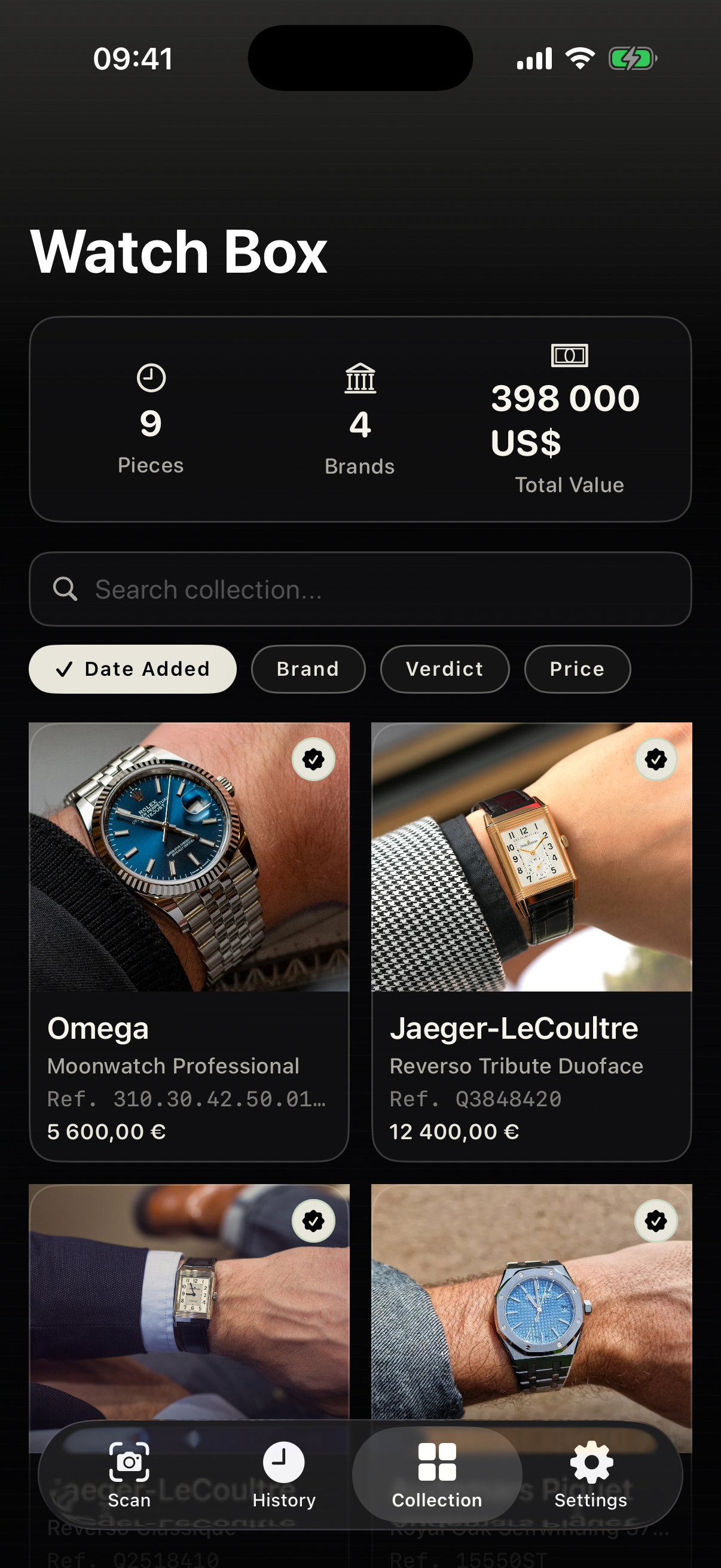
- Keeping a valuation on pieces you already own — the collector’s watch box.
- Comparing authentication routes — WatchRadar and Entrupy side by side.