Why JLC counterfeits are rarer — but more interesting
JLC is a connoisseur’s brand. The buyers know what they are looking at, which means counterfeit operations targeting JLC have to clear a higher bar to fool anyone. The Reverso’s flip case alone defeats most attempts — replicating the rack-and-spring mechanism that locks the case in either orientation requires real watchmaking. What you actually see in counterfeit JLC: weak Master Control fakes (where the case is the only thing that needs to look right) and dressed-up Memovox fakes that fail on the alarm chiming mechanism.
The seven tells the AI grades on every Jaeger-LeCoultre
1. Reverso swivel-frame engraving
The Reverso swivel cradle has parallel grooves engraved (not stamped) along the long edges with measurable depth. The pivot rivets sit flush. Counterfeit cradles are typically stamped, with grooves that are visibly shallow, and rivets that protrude.
2. Reverso reverse-side finishing
The flip-side of a Reverso is either polished plain (engravable), guilloché, or set with a complication dial. The polish should be optical-grade with no machining marks. WatchRadar checks the reverse-side finishing along with the front.
3. Dial typography
JLC dials use a specific serif typeface for "JAEGER-LECOULTRE" with a hyphenated wordmark. The "Q" in "Reverso", the "M" in "Master", and the "P" in "Polaris" have characteristic shapes. WatchRadar flags incorrect kerning and missing/swapped characters.
4. Calibre engraving (display backs)
JLC’s in-house movements (calibres 822, 853, 854, 970, 943, 947) are signed and finished to a high bar. The bridges have hand-applied Côtes de Genève and Geneva-style anglage. WatchRadar reads the bridge engraving with OCR through sapphire and checks the striping pitch.
5. Hand finishing
JLC uses heat-blued steel hands or polished gold hands depending on reference. The colour transition on blued hands and the polishing quality on gold hands are repeatable. Counterfeit hands tend to be painted blue or have machine-stamped polish.
6. Case proportions
Reverso cases come in specific sizes — Classique, Medium, Grande, Tribute. The case-to-cradle ratio is precisely held. WatchRadar measures case proportions in the case angle of the five-angle scan and compares to the reference catalogue.
7. Memovox alarm tone (manual check)
On Memovox references, the alarm chime should ring at a specific tone and duration. WatchRadar surfaces a recommendation to test the alarm in person — a non-functioning or wrong-tone alarm on a Memovox is a strong fake-tell that the app flags but cannot directly verify from photos.
Cradle, caseback and papers — the JLC paper trail
A Reverso has two "backs" — the reverse case face and the cradle it swivels inside — and the identifying marks are split between them. That is unusual, and it is where mis-described watches get caught.
- Where the numbers live. On a Reverso, the case number and reference are cut into the cradle or the case flank rather than a conventional caseback, because the reverse face is a display or engraving surface. On a Master Control or Polaris the numbers sit on the caseback rim in the usual place. A Reverso whose numbers are on the reverse face itself is not a variant — it is a fake built on a conventional case.
- The 1000 Hours Control mark. JLC subjects finished watches to its own multi-week 1000 Hours Control test and marks certified pieces accordingly, with the certification recorded against the individual watch. On a modern reference, an absent or unverifiable 1000 Hours Control claim is worth resolving with the boutique before purchase.
- Bridge finishing through the display back. JLC’s in-house calibres carry hand-applied Côtes de Genève and beveled (anglage) bridge edges that catch light as a bright line along every edge. Machine-finished counterfeit movements have flat, matte bridge edges. WatchRadar reads the striping pitch and the presence of that bright anglage line — it is one of the few genuinely hard-to-fake signals visible without opening a case.
- Papers and the archive extract. JLC supplies an extract from its archives for older references, and enrolling a modern watch with the manufacturer extends its service coverage. For any vintage Reverso — the pre-1990 Geometric editions above all — the extract is the strongest single document you can hold, and the dossier is designed to sit next to it.
Models WatchRadar handles best
- Reverso Classic / Tribute — Q397848J, Q3858520, Q2548540, Q3902420.
- Reverso Duoface / Duo — Q3848420, Q2712410, Q3994420.
- Master Control / Master Ultra Thin — Q1548530, Q1342520, Q1338420.
- Polaris — Q9038180, Q9028180, Q9008181 ("Mariner").
- Memovox / Geographic — Q1418430, Q1428430.
- Master Compressor — vintage Master Compressor diving and chronograph references.
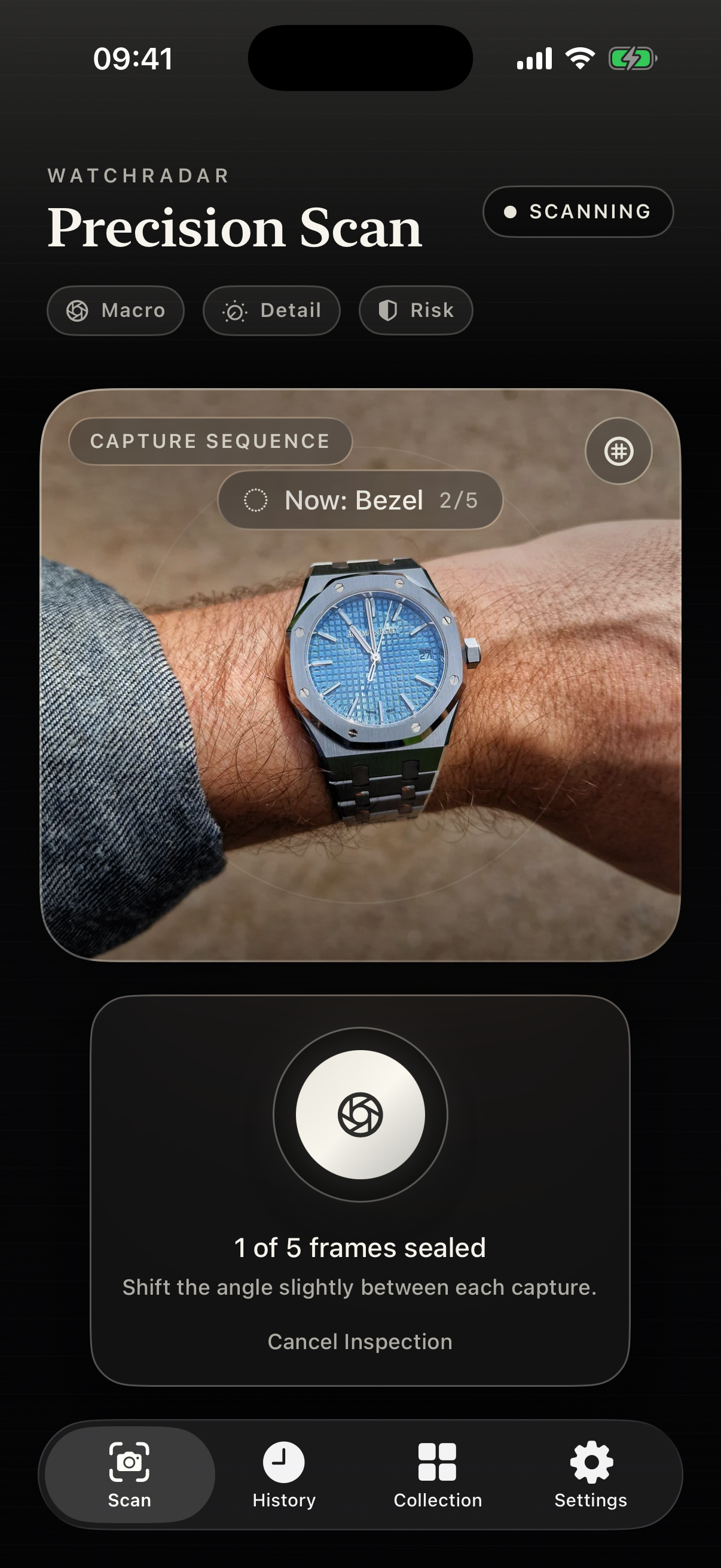
How to run the five-angle scan on a Jaeger-LeCoultre
A Reverso is the one case in this catalogue that has to be scanned twice — once per face. On a Master Control or Polaris the standard five frames apply.
Front dial, straight on
Square the dial and get close enough to resolve the hyphenated JAEGER-LECOULTRE wordmark. This frame carries the dial typography, the applied or printed marker geometry, and the hand finishing. On a Duoface, note which face you are shooting — the reverse dial is a different reference fingerprint, not a duplicate.
Reverse face, swivelled through 180°
Flip the case in its cradle and shoot the reverse square-on. Whether it is plain polished, guilloché or a second dial, the finishing standard should match the front. Optical-grade polish with no machining marks is the expectation; visible tool marks on a plain reverse face are a strong negative signal.
Cradle long edge, raking light
Rake a light along the cradle’s long edge and shoot it in profile. The parallel grooves should be cut rather than stamped, with measurable depth and no rolled edges, and the pivot rivets should sit dead flush with the surrounding metal. This is the frame that most often ends a counterfeit Reverso.
Display back, or caseback square-on
On a Master Control, Polaris or display-back Reverso, shoot the sapphire flat and let the OCR read the calibre engraving. What matters as much as the text is the light behaviour: hand-beveled bridge edges throw a bright line, machine-cut ones do not. On solid backs, this frame reads the reference and case number cuts instead.
Strap or bracelet with the buckle, flat
Lay the strap out with the buckle visible. JLC buckles are signed, and on integrated-bracelet Polaris references the link play and the case-to-bracelet seam are checked here. Aftermarket straps are common and are recorded as a provenance note, not a verdict failure.
Other brand guides
- Cartier: Tank, Santos and Ballon Bleu tells — the other maker where blued-steel hands and case proportion carry most of the verdict.
- Patek Philippe: Nautilus and Calatrava tells — hand-finishing evidence read the same way.
- Omega: Speedmaster and Seamaster tells — the closest comparison for reading a calibre through sapphire.
- Rolex: cyclops, rehaut and bracelet checks.
- Audemars Piguet: Royal Oak tapisserie and screws.
- Start at the brand authentication hub for the per-maker weighting.
Reading this before a specific kind of JLC deal?
- Buying a vintage Reverso — the pre-purchase inspection walkthrough covers the frames and papers to ask for.
- Handling consignment stock — the reseller verification pipeline.
- Building a considered collection — the collector’s watch box.
- Comparing authentication routes — WatchRadar and Entrupy side by side.