
Why the 5711 became such a target
Gérald Genta’s 1976 Nautilus was a steel sports watch from a maker known for gold dress watches. The 5711/1A, introduced in 2006, became the reference everyone wanted: waiting lists at retail stretched for years and secondary prices climbed far above list. In January 2021 Patek Philippe confirmed the 5711/1A would be discontinued, with an olive-green dial as the send-off that year and a Tiffany Blue co-signed limited edition at the end of it.
That price gap is what funds counterfeits, and the 5711’s simple time-and-date layout makes it easier to copy than a complication. It is now among the most widely copied luxury steel watches. The better fakes get the silhouette and colour right, and struggle with the embossed dial, the finishing and the movement behind the sapphire back.
The Nautilus references this guide covers
- 5711/1A (2006 to 2021). Time and date, 40 mm, water-resistant to 120 metres, sapphire display back. Most carry calibre 324 S C; from 2019 Patek fitted the 26-330 S C, and early examples used the older 315 S C. Blue dial (5711/1A-010), olive green in 2021 (5711/1A-014).
- 5712/1A. Moon phase, power reserve, date and small seconds on off-centre subdials, driven by the micro-rotor calibre 240 PS IRM C LU. Introduced in 2006; the steel version was quietly discontinued in early 2025.
- 5726. Annual calendar with moon phases and 24-hour indication. The current steel 5726/1A-014 uses calibre 26-330 S QA LU 24H and is rated to 30 metres.
- 5980. The first Nautilus chronograph, a flyback on calibre CH 28-520 C, with a single counter at 6 o’clock that shows elapsed minutes and hours on two concentric scales.
- 5990/1A. Flyback chronograph plus Travel Time on calibre CH 28-520 C FUS: two hour hands for local and home time, day and night apertures for each, and time-zone pushers on the 9 o’clock side of the case. Rated to 30 metres.
Fake Nautilus vs real: the side-by-side
| Detail | Genuine | Common fake |
|---|---|---|
| Dial | Embossed horizontal ridges with real depth that shift in light | Printed or shallow lines; flat colour with no play of light |
| Markers and hands | Applied white-gold batons with luminous fill, cleanly parallel | Markers slightly out of line; lume spilling past the metal |
| Case “ears” | Crisp, symmetrical hinges at 3 and 9; sharp finish lines | Rounded, soft ears; polish blurring into brushed areas |
| Display back (5711) | Calibre 324 S C or 26-330 S C with a 21K gold central rotor | Generic movement with decoration that only looks similar |
| Hallmark | Patek Philippe Seal on watches made after its 2009 introduction | Missing, blurred, or a hallmark that does not fit the year |
| Seconds when setting | Stop on the 26-330 S C (from 2019); keep running on the 324 S C | Behaviour that contradicts the calibre and year on the papers |
| 5712 movement | Off-centre micro-rotor | Full central rotor behind the sapphire |
| Bracelet and clasp | Brushed links with narrow polished centre links, fold-over clasp, no gaps | Polish bleeding into brushed surfaces, gaps at the case, rattle |
Nine tells that give away a fake Nautilus
1. The embossed horizontal dial
Patek describes the Nautilus dial as horizontally embossed, and the ridges have real relief. Tilt the watch under one light and bands of light should travel across the dial; printed or shallow lines stay flat. On the blue 5711/1A-010 the colour also darkens towards the rim.
2. Markers, hands and date
The hour markers are applied white-gold batons with luminous fill, and the hands are matching batons. Every marker should point exactly at the centre, with the lume contained inside the metal. On the 5711 the date sits at 3 o’clock in a clean window with a sharp, well-centred numeral. Crooked markers and a crowded or off-centre date are common fake tells.
3. The porthole case and its ears
The case takes its shape from a ship’s porthole, with a hinge-like “ear” on each side at 3 and 9 o’clock. The bezel top is brushed and its edges polished, with a sharp line where one finish meets the other. Fakes tend to soften the ears, round the corners of the bezel and let the polish drift into the brushed surfaces.
4. The right calibre behind the glass
Every reference here has a sapphire display back, so the movement is part of the inspection. A 5711 should show calibre 324 S C, the 26-330 S C from 2019, or on the earliest examples the 315 S C. A 5712 shows the small off-centre rotor of the 240 PS IRM C LU; a full central rotor on a 5712 is a hard fail. The 5980 and 5990 show Patek’s CH 28-520 chronograph family.
5. The gold rotor and the Patek Philippe Seal
The central rotor on the 324 S C and 26-330 S C is 21K gold, and the movement carries the Patek Philippe Seal, the maker’s own hallmark since 2009. Watches made before then carried the Geneva Seal instead. Blurred engraving, or a hallmark that does not fit the production year, is a warning.
6. Seconds that stop, or do not
The 26-330 S C, fitted from 2019, stops the seconds hand when you pull the crown to set the time. The earlier 324 S C does not. Check it against the calibre and the year on the papers. Clones can copy either behaviour, so this is a consistency check, not proof.
7. Complications in the right places
On complicated references every indication should work and sit where Patek put it. The 5980 has one counter at 6 carrying minutes and hours together. The 5990 has its 60-minute counter at 6, local and home day-night apertures, and time-zone pushers on the left flank. Decorative subdials, apertures that never change or pushers on the wrong side are tells.
8. The integrated bracelet and fold-over clasp
The bracelet flows straight out of the case with no visible gap, alternating broad brushed links with narrow polished centre links, and closes with Patek’s fold-over clasp. Gaps, sharp edges and polish that bleeds into the brushing are tells.
9. Papers, numbers and rare dials
Each Patek has a case number and a movement number, and both should match the original papers. The green 2021 dial and the Tiffany Blue co-signed edition are among the most sought-after 5711 variants, which makes them targets too. Any rare dial with thin or missing provenance should be treated as high risk until Patek’s own records say otherwise.
What photos cannot show on a Nautilus
- The whole movement. The display back shows the rotor side and the bridges. It does not show the dial side, the movement number in context, or whether a genuine-looking movement has been paired with a replica case. A watchmaker opening the case can check all of that.
- Water resistance. The 5711 is rated to 120 metres, the 5726 and 5990 to 30. Only a pressure test shows whether a particular case holds its rating.
- Weight, gold and records. Photos cannot weigh the watch, confirm that a rotor is solid gold, or show what Patek’s archive says about the case and movement numbers.
At Nautilus prices, every purchase deserves more than photos. Have a watchmaker experienced with Patek Philippe open the case, or take the watch to Patek Philippe’s service network, and request an Extract from the Archives to confirm the case and movement numbers were made together. The buyer’s walkthrough covers what to ask a seller before any of that.
How to photograph a Nautilus for a WatchRadar scan
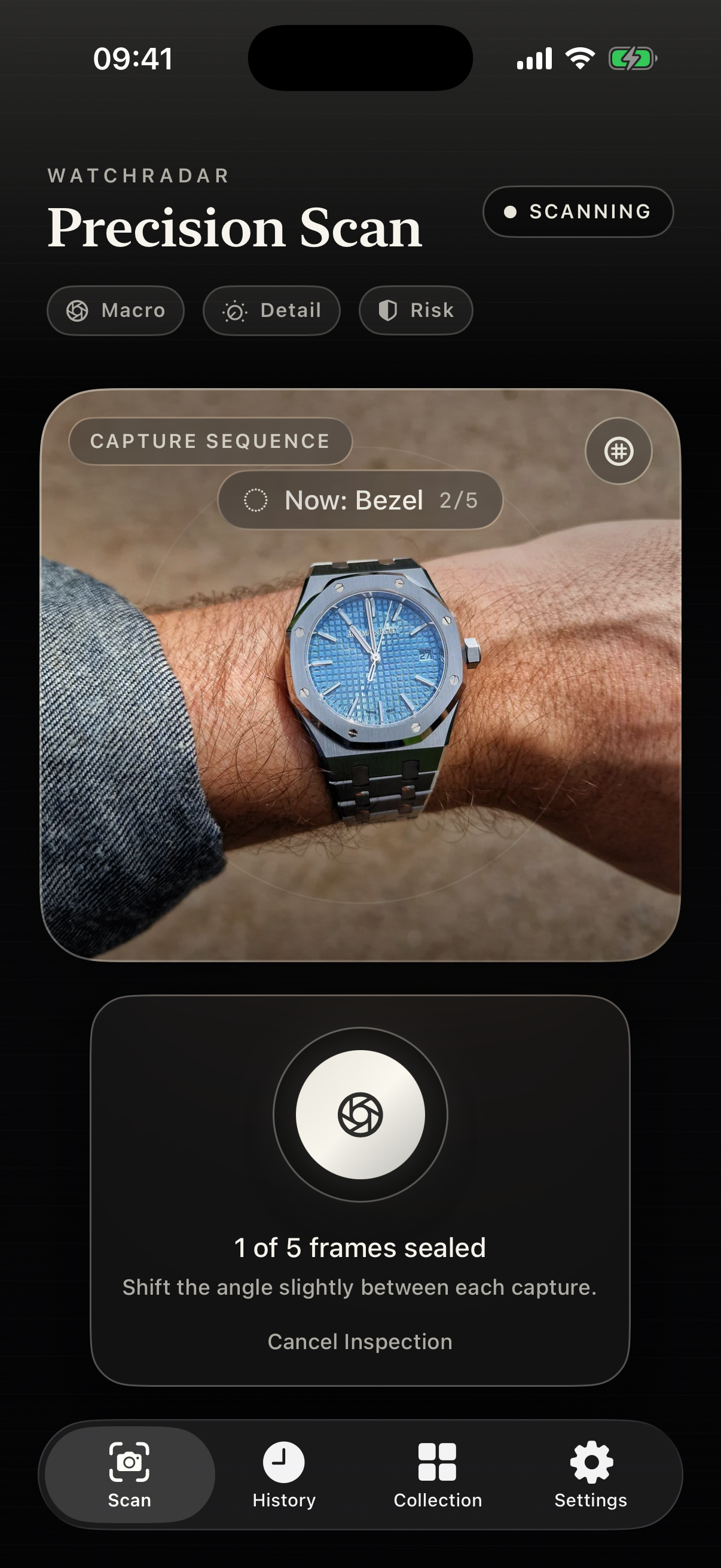
WatchRadar can start with three useful angles; five give it stronger evidence. On a Nautilus the embossed dial and the case finishing only show their depth when light rakes across them.
Dial, nearly straight on, tilted to catch the embossing
Square the dial to the camera, then tilt it a few degrees until the horizontal ridges catch a band of light. Keep the date window and every marker sharp, with one light source to the side.
Bezel and ears, from about 20 degrees
Tip the watch so the bezel top, its polished edges and both ears are in one frame. Raking light shows the line between brushed and polished surfaces, which is where fakes lose.
Crown side, in profile
Shoot the 3 o’clock flank at case height so the crown and the right-hand ear are in focus. On a 5990, take a second frame of the 9 o’clock flank to show the time-zone pushers.
Display back, square on
Photograph the sapphire back straight on, angled just enough to lose reflections, so the rotor, the calibre designation and the hallmark are legible.
Bracelet and fold-over clasp, clasp open
Lay the bracelet flat with the clasp open so the clasp signature, the link finishing and the point where the bracelet meets the case are all visible.
WatchRadar uploads the photos for analysis on its servers. It suggests the likely reference with a confidence level, reads the dial and caseback text it can see, and returns a hedged verdict (Likely authentic, Uncertain or High risk) with the reasons and a recommended next step. It also shows an estimated secondary-market value range next to the asking price, which matters on a watch whose price moves as much as the 5711’s. When the photos cannot settle a question, the verdict is Uncertain.
More model guides
- Patek Philippe guide: brand-wide checks, the Seal and the paper trail.
- How to spot a fake Audemars Piguet Royal Oak, the Nautilus’s closest rival in design and in counterfeit pressure.
- How to spot a fake Rolex Daytona, GMT-Master II and Submariner.
- How to spot a fake Omega Speedmaster.
- Not sure which reference you have? Start with the watch identifier.