
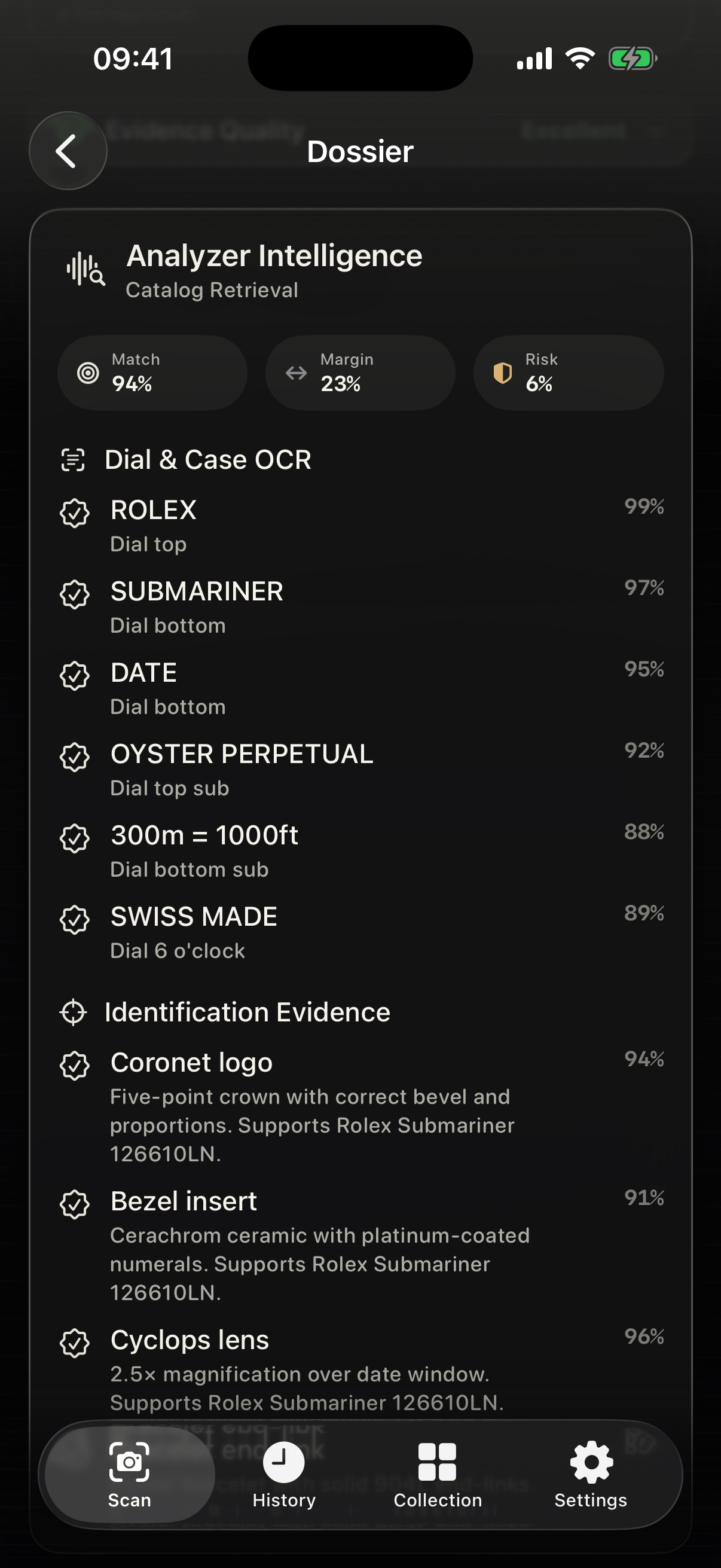
What an AI watch identifier does
A watch identifier answers the question behind most watch searches: what is this, exactly? The brand is usually the easy part, because it is printed on the dial. The hard part is the model and the reference number, the manufacturer’s code for one specific combination of case, dial, bezel, metal and bracelet. Two watches that look alike from across a room can be different references, made decades apart, and worth very different amounts.
An AI identifier works the way an experienced collector looks at a photo. It reads the text it can see, compares shapes and proportions with the references it knows, and weighs the clues against each other. The useful output is not just a name. It is a name, a confidence level and the evidence behind it, so you can judge the suggestion yourself.
What the identifier reads in your photos
Logo and brand signature
Whether the logo is applied or printed, its shape and its position on the dial. The brand name is usually the first clue, but the way it is rendered also separates eras of the same brand.
Dial text
Model name, depth rating, chronometer lines, the country line at 6 o’clock. These lines are often the fastest route to a model family: “Submariner” together with a “300m” depth rating narrows the field quickly.
Case shape
The silhouette, lug shape, crown guards and the proportion of case to dial. A Royal Oak’s octagonal bezel or the flat vertical sides of a Cartier Tank identify the family before any text is read.
Bezel
Diving scale, tachymeter, 24-hour GMT scale, fluted, smooth or screwed. Within one model family, the bezel is often what separates one reference from the next.
Hands and markers
Hand shapes, applied indices or printed numerals, the date window and whether it has a magnifier. Small changes here mark different references and generations.
Caseback engraving
Model and reference numbers, serial numbers, metal stamps and water-resistance text. Many brands engrave identifying numbers here, which makes the caseback the single most useful photo for pinning down a reference.
How WatchRadar suggests a brand, model and reference
WatchRadar guides the capture on your iPhone: live framing, sharpness and glare checks, and a quick read of visible text, so a blurred or washed-out frame is retaken before it counts. The photos are then uploaded and analysed on WatchRadar’s servers, where the identification runs.
The result names the likely brand, model and reference with a confidence level. Underneath, the dossier lists the dial and caseback text it read and the visual signals it used, each marked as supporting or contradicting that identity. If the dial says one model and the bezel belongs to another, you see the conflict rather than a confident-sounding answer.
When the evidence is thin (a single blurred photo, a heavily worn dial, an obscure maker) the answer is Uncertain. That is deliberate. A wrong reference delivered with confidence costs more than an honest “not sure”, especially when you are about to price or buy the watch.
The same scan gives a hedged verdict on risk signals (Likely authentic, Uncertain or High risk, with the reasons) and an estimated secondary-market value range. Our valuation guide explains how to read that range, and the brand guides cover the details worth checking on each make.
How to identify your watch with WatchRadar
Three angles are enough to start a scan. Five give stronger evidence, and the caseback is the frame most likely to settle the reference.
Install WatchRadar on an iPhone running iOS 26 or later
Download the app from the App Store. Your first full analysis is free, so you can try it on the watch you are curious about before deciding whether you need WatchRadar Pro.
Photograph the dial straight on
Square the watch to the camera and keep the light off to one side so the crystal does not flare. This frame carries the logo, dial text, hands and markers, which is most of what the identifier reads first. The app flags glare or blur before you move on.
Capture the bezel and the crown side
Tilt the watch slightly so the bezel scale reads clearly, then shoot the crown side in profile. Bezel type and crown details often separate two references in the same family.
Turn it over for the caseback and the clasp
Photograph the caseback square on, with the light raking across it so the engraving throws shadows. Many brands engrave reference or serial numbers here. Add the clasp or buckle if you can: its signature and stamps are extra evidence.
Read the suggestion and the evidence behind it
Check the suggested brand, model and reference, the confidence level and the supporting and contradicting signals. If the result is Uncertain, retake the weakest frame, add the caseback if you skipped it, or read the reference yourself using the manual method below.
How to identify a watch without an app
You do not need software to identify most watches. You need good light, patience and ideally a loupe or your phone’s camera zoom. This is the method dealers use:
- Read the dial signature. Note the brand and every line of text: model name, depth rating, “Automatic”, “Chronometer”, the country line at 6 o’clock. Write it down exactly as printed, because spelling and layout matter.
- Find the reference number. Depending on the brand, it is engraved on the caseback (TAG Heuer, Breitling), between the lugs under the bracelet (Rolex, older Tudor), stamped inside the caseback (vintage Omega) or printed only on the papers (Audemars Piguet, most modern Omega). Our guide to finding a watch’s reference and serial number goes brand by brand.
- Search the reference, not a description. “126610LN” returns one watch; “black Rolex diver” returns thousands. Search the exact reference on the brand’s site, in auction archives and in dealer listings.
- Compare the details. Check the hands, markers, bezel, date window and case against photos of that reference. A mismatch can mean a replaced part, a mislabelled listing, or a watch that is not what it claims to be.
- Use the papers, but check them. Warranty cards and service receipts usually list the reference and serial. They are the easiest place to start, but papers can be swapped, so confirm they match the watch.
The manual method is slower, but it teaches you the watch. It struggles in two situations: when the reference is hidden, under a bracelet or inside a closed caseback, and when the dial is unbranded, refinished or worn. That is where an identifier, a forum or a watchmaker earns its place.
Ways to identify a watch, compared
| Method | Good for | Where it falls short | Cost |
|---|---|---|---|
| App photo scan (WatchRadar) | Quick brand, model and reference suggestions with a confidence level and the evidence behind them; reads dial and caseback text; adds risk signals and an estimated value range | Needs clear photos; may return Uncertain on obscure or heavily modified watches; cannot see inside the case | First full analysis free, then WatchRadar Pro |
| Reverse image search (Google Lens and similar) | Finding similar-looking watches and listings fast; works well on famous designs | Matches appearance, not the reference; confuses lookalike references and replicas; gives no confidence level or reasoning | Free |
| Reading the reference yourself | The most precise answer when the number is visible, and you can verify it | Often hidden under a bracelet or inside the case; engravings wear; some brands do not engrave it at all | Free (a loupe helps) |
| Asking a watch forum | Obscure, vintage and military pieces; enthusiasts recognise details no database covers | Slow and uneven; answers depend on who replies; public photos can expose your serial number | Free |
| A watchmaker or the brand | Definitive answers: a watchmaker can open the case and read the movement; Omega and Patek Philippe sell archive extracts based on the serial | Takes days or weeks; opening the case needs a professional; extracts are paid and not every brand offers them | Paid |
Most people end up combining two: a scan or a search to get a candidate reference, then a check of the engraved number or the papers to confirm it. For a valuable watch, finish with a watchmaker.
Identification guides by brand
Every brand puts its numbers somewhere different and has its own lookalike traps. Start at the brand guide hub, or go straight to a brand:
- Rolex: the reference is between the lugs at 12 o’clock; on modern watches the serial is on the rehaut at 6 o’clock. To date one, see the Rolex serial number chart.
- Omega: modern references are a long dotted code, such as 310.30.42.50.01.001 for a Speedmaster Moonwatch Professional, found on the papers rather than the case.
- Cartier: a four-digit model number and an individual serial are engraved on the caseback.
- Audemars Piguet: the reference is rarely engraved on the watch; the letters after it give the metal (ST for steel, OR for pink gold).
- Patek Philippe: each watch is recorded by a movement number and a case number, both listed on the Certificate of Origin.
- Jaeger-LeCoultre: the Reverso’s swivelling case is unmistakable, but size and generation take a closer look.
- Tudor: shares design cues with Rolex; current references carry an M prefix on the papers, such as M79230N for a Black Bay.
- Breitling: the reference is on the caseback and starts with a letter for the case metal (A for steel).
- TAG Heuer: reference and serial are engraved on the caseback, the reference usually above the serial.
- IWC: Pilot’s Watch, Portugieser and Portofino families look alike across generations; the reference separates them.
- Panerai: models are known by their PAM number, which is how collectors and dealers name them.
- Hublot: Big Bang and Classic Fusion come in many sizes and materials, and the reference is what tells them apart.
What identifying a watch can and cannot tell you
Identifying a watch tells you what it presents itself as. It does not prove the watch is genuine, original or unmodified. A counterfeit is made to be identified as the real reference; that is the whole point of it. That is why WatchRadar reports risk signals separately from the identification, and why a Likely authentic verdict is a hedged reading of photos, not a verification.
Once you know what it is
- Wondering what it is worth: how much is my watch worth? explains what moves prices and how to read an estimated range.
- Want to know its age: for a Rolex, date it from the serial; for other brands, start with the reference and serial guide.
- Keeping it: the collection box stores the watch with its photos, receipts, service history and past reports.
- Buying it: the pre-purchase walkthrough lists the photos to ask for before any money moves.