
Why Tudor is counterfeited, and which models are targeted
Tudor sits in an awkward place for buyers. Its history is close enough to Rolex to carry the halo, and its prices are low enough that many buyers skip a professional inspection. The Tudor name was registered in 1926 on behalf of Hans Wilsdorf, the founder of Rolex, who set up Montres Tudor SA in 1946. For decades Tudor watches used Rolex Oyster cases and Rolex-signed crowns around bought-in movements.
The modern revival began with the Heritage Black Bay in 2012, and the Black Bay family is what counterfeiters copy most: the 41 mm Black Bay, the 39 mm Black Bay 58, the Black Bay GMT with its red and blue bezel, and the titanium Pelagos. Replicas of these models are made to survive a glance, so the useful checks are about consistency: does every part belong to the same reference and the same year? Vintage is a separate problem. Tudor Submariners and Oyster Princes with Rolex-signed parts attract "franken" watches assembled from mixed genuine and fake components.
Rose or shield: matching the Tudor logo to the era
The logo is the fastest era check on a Tudor, because the brand changed it once and then brought the old one back for its heritage models.
- The rose era. From the late 1940s until 1969, dials carried the Tudor rose. That includes the first Oyster Prince Submariner, ref. 7922 of 1954, and the 1958 "Big Crown" ref. 7924.
- The shield era. In 1969 Tudor dropped the rose and kept the shield, first on the Submariner ref. 7016, the same watch that introduced snowflake hands. Most Tudor dials since then carry the shield.
- The heritage rose. The Heritage Black Bay ref. 79220 (2012 to 2016) put the rose back on the dial, above a curved line of text at 6 o’clock, with an ETA 2824 movement inside.
- Shield on the dial, rose on the crown. In 2016 the ref. 79230 moved to Tudor’s own MT5602 calibre and returned to the shield on the dial, while the rose stayed on the crown. A rose dial on a watch sold as an MT-calibre Black Bay is a mismatch worth resolving before money moves.
What to check on a Tudor: seven brand-specific tells
1. Snowflake hand geometry
Designed for the French Navy and introduced on the Submariner 7016 in 1969, the snowflake hour hand carries a large square luminous plot, paired with a long baton minute hand. On a Black Bay, Black Bay 58 or Pelagos the square should have crisp corners, an even metal frame and lume filled flush. Fakes often round the corners, shrink the square or leave the frame uneven.
2. Dial text that matches the calibre
The ETA-powered 79220 has one curved line of text below the logo, which collectors call the smile. The MT5602-powered 79230 has two straight lines stating that the watch is a COSC-certified chronometer. Dial text is cheap to copy on its own, which is why it has to agree with the logo, the caseback and the papers.
3. Bezel insert material
The steel Black Bay 58 and the 79230 Black Bay use a matt anodised aluminium bezel disc; the Pelagos uses a matt ceramic disc. A glossy ceramic insert on a steel Black Bay 58, or a shiny, printed-looking insert on a Pelagos, does not match the reference.
4. Riveted-style bracelet
The MT-era Black Bay bracelet imitates the riveted Oyster bracelets of the 1950s, with rivet heads on the sides of solid links. On counterfeits the rivets are often shallow, printed or unevenly spaced, and the links are folded or hollow, which shows at the link edges and the end-links.
5. T-fit clasp action
Tudor introduced the T-fit clasp on the Black Bay 58 Bronze in 2021 and has rolled it out since: a tool-free, five-position micro-adjustment with about 8 mm of travel. On a watch that should have it, the clasp slides and locks positively. A T-fit on a reference that predates it needs an explanation, such as a later replacement bracelet.
6. Pelagos titanium, valve and clasp
The Pelagos case and bracelet are titanium, which looks greyer and duller than polished steel and feels much lighter. The 42 mm Pelagos has a helium escape valve on the case flank (the Pelagos 39 does not), and its clasp has a patented self-adjusting spring that lets the bracelet expand and contract during a dive. Fakes often use steel or a spring that does not move.
7. Rolex-signed parts on vintage Tudors
Vintage Tudor Submariners such as the 7922 and 7924 were built in Rolex Oyster cases, with Rolex-signed crowns and casebacks reading "Original Oyster Case by Rolex Geneva". Those parts are exactly what fakers reproduce and what franken builders swap in. Engraving depth, font and the crown profile need a specialist to confirm.
Where is the serial number on a Tudor? The caseback and paper trail
Four checks sit outside the usual listing photos. Ask for them before you agree a price.
- The serial position. On vintage Oyster-cased Tudors the serial is engraved between the lugs at 6 o’clock and the reference between the lugs at 12, as on a Rolex of the same age, so the bracelet has to come off. On modern references Tudor moved the serial to the case beside the caseback (under a lug on some models, around the caseback rim on others), so it can often be photographed with the bracelet on. The exact spot varies by family; what matters is that the engraving is sharp, evenly spaced and matches the papers.
- The caseback. Most Tudor divers have a solid screw-down caseback with engraved text. The MT-era 79230 has a slightly domed caseback where the 79220 was flat. A few recent references, such as the Black Bay Ceramic, have a sapphire display back. A display back on a steel Black Bay 58 (79030N or 79030B) or on a 79230 is a hard stop.
- The reference format. Tudor writes modern references with an M prefix and a variant suffix, for example M79030N-0001 for the black Black Bay 58. Since 2023 some references use a longer alphanumeric code, such as M7941A1A0RU for the Master Chronometer Black Bay. The reference on the card and the invoice should match the watch in front of you.
- The warranty card. Tudor extended its warranty to five years for watches sold from 1 January 2020, transferable between owners and valid when an Official Tudor Retailer completes the card at the time of sale. Check the serial and reference against the case, and the date against the model’s launch: a Black Bay 58 card dated before 2018 cannot be right. Cards are copied too, so treat one as supporting evidence rather than proof.
In-house MT calibres vs ETA-based Tudors
In 2015 Tudor began fitting its own MT ("Manufacture Tudor") calibres: the MT5621 in the North Flag and the MT5612 in the Pelagos, followed by the MT5602 in the Black Bay in 2016 and the MT5402 in the Black Bay 58 in 2018. They are COSC-certified, run at 28,800 vibrations per hour, use a silicon balance spring and have a power reserve of about 70 hours. They were developed with Kenissi, a movement maker in which Tudor holds a stake. Before that, models such as the 79220, the first Pelagos (25500TN) and the 2014 Heritage Ranger used ETA-based movements with a reserve of about 38 hours. The Tudor Royal, launched in 2020, uses Sellita-based T600-series calibres rather than an MT movement.
That gives you a practical home test. Wind an MT-era watch fully, leave it face-up and see whether it runs for most of three days. A watch sold as an MT5602 Black Bay that stops after a day and a half is either overdue for a service or not what the listing says. Tudor also swapped movements with Breitling: the MT5813 in the Black Bay Chrono is derived from the Breitling B01, and Breitling’s B20 is derived from the MT5612. See the Breitling guide for the other side of that exchange.
Tudor references worth knowing before you buy
- Black Bay (41 mm): 79220 (rose dial, ETA, 2012 to 2016), 79230 (shield dial, MT5602, from 2016), M79210CNU (Black Bay Ceramic, 2021), M7941A1A0RU (Master Chronometer, 2023).
- Black Bay 58 and Black Bay 54: 79030N (black, 2018), 79030B (navy blue, 2020), 79012M (bronze), 79010SG (925 silver), 79018V (18k gold), 79000N (Black Bay 54, 37 mm, 2023).
- Black Bay GMT, Pro and Chrono: 79830RB (GMT, 2018), 79470 (Black Bay Pro, 2022), both with the MT5652; 79360N (Black Bay Chrono, MT5813).
- Pelagos: 25500TN (2012, ETA-based), 25600TN and 25600TB (2015, MT5612), 25610TNL (Pelagos LHD, crown on the left), 25407N (Pelagos 39, 2022, MT5400), 25707B (Pelagos FXD).
- Ranger: 79910 (Heritage Ranger, 41 mm, 2014, ETA-based), 79950 (39 mm, 2022, MT5402).
- Royal: 28600 (41 mm), 28500 (38 mm), 28400 (34 mm) and 28300 (28 mm), with a notched bezel and integrated bracelet.
- Vintage Submariner: 7922, 7924 "Big Crown", 7016 and 7021 (the first snowflake-hand references).
How to photograph a Tudor for a WatchRadar scan
A scan can start with three useful angles; all five below give stronger evidence. The app checks framing, sharpness and glare on the iPhone while you shoot, then uploads the photos to WatchRadar’s servers for analysis.
Dial, square-on, logo and hands sharp
Centre the dial and fill the frame. This photo carries the rose or shield logo, the snowflake hour hand and the lines of dial text that should match the calibre. Black Bay and Black Bay 58 crystals are domed sapphire, so keep your light off to one side or a bright streak will cross the logo.
Bezel, tilted about 15 degrees
Tilt the watch until the whole bezel ring is in frame and its surface catches soft light. Matt aluminium, matt ceramic and glossy ceramic read differently at this angle, and on a Black Bay GMT this is where the two-tone insert and the 24-hour scale are read.
Crown side, in profile at case height
Shoot the 3 o’clock side level with the case (the 9 o’clock side on a Pelagos LHD). On a Black Bay this shows the large crown with no crown guards and the rose on the crown face. On a 42 mm Pelagos, take a second photo of the opposite flank for the helium escape valve.
Caseback, flat and evenly lit
Lay the watch face-down and photograph the caseback straight on, with the serial engraving included if it sits on the rim or under a lug. WatchRadar reads the visible text, and this photo also shows whether the back is solid or sapphire and whether its shape suits the generation.
Clasp open, bracelet flat
Open the clasp and lay the bracelet flat so the rivet-style links, the clasp engraving and the T-fit slider are all visible. On a Pelagos, include the self-adjusting spring section of the clasp.
What WatchRadar does with a Tudor scan
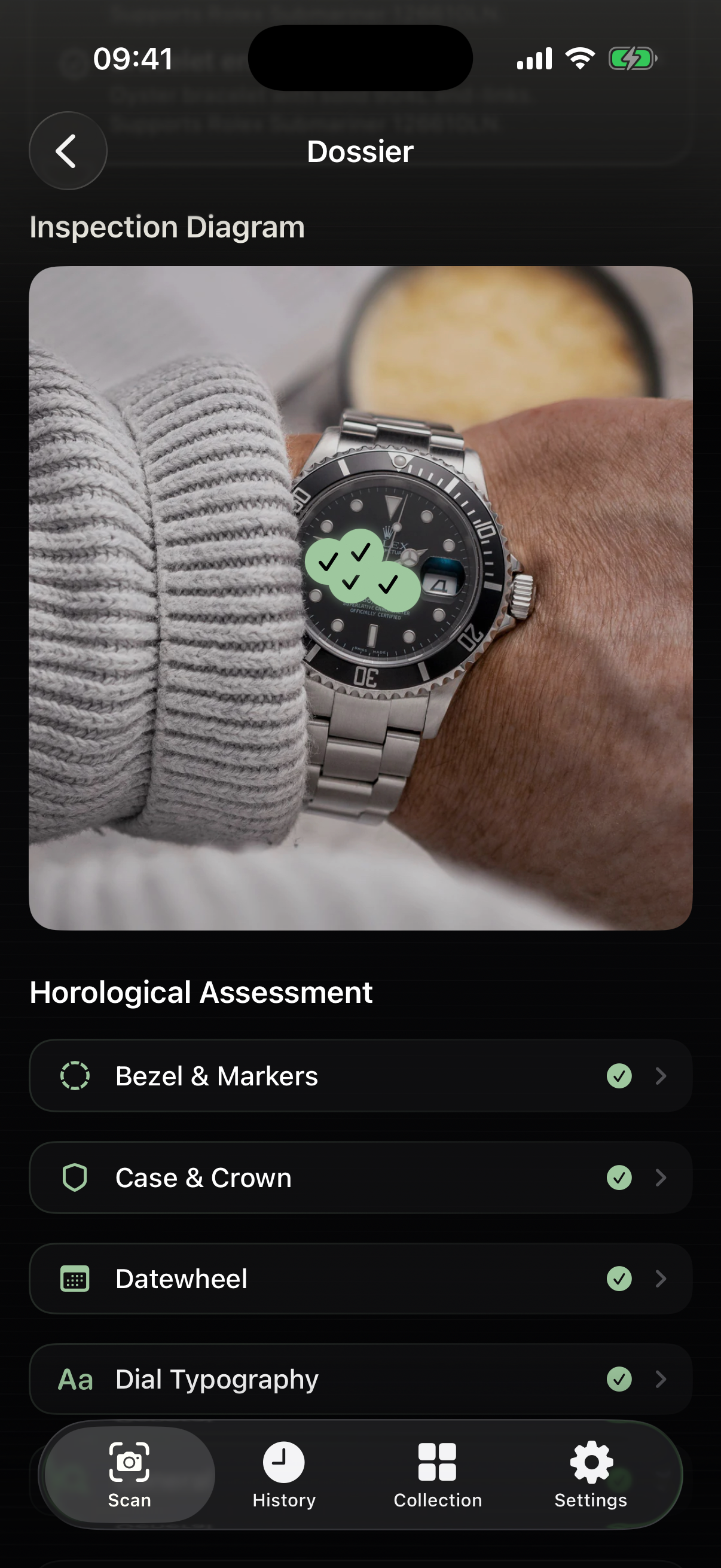
From those photos WatchRadar suggests the likely model and reference with a confidence level, reads the visible dial and caseback text, and explains which signals support that identity and which contradict it, such as a rose dial on a watch otherwise matching a 79230. You get a hedged verdict (Likely authentic, Uncertain or High risk) with the reasons and a recommended next step, plus an estimated secondary-market value range next to the asking price you enter. When the photos do not show enough, the verdict is Uncertain rather than a guess.
The result can be saved to your collection box or shared as an analysis certificate with a unique WRC ID and a QR code that opens the public verification page. It is a record of the analysis, not a legal document.
Other brand guides
- Rolex: the sister brand, with the cyclops, rehaut and bracelet checks that vintage Tudor parts share.
- Breitling: Navitimer slide rule, B01 layout and the movement exchange with Tudor.
- Omega: Speedmaster and Seamaster checks.
- TAG Heuer: Carrera, Monaco and the quartz vs automatic question.
- Cartier: Tank and Santos checks.
- IWC: Pilot’s Watch and Portugieser checks.
- Panerai: Luminor and Radiomir checks.
- Hublot: Big Bang checks.
- Audemars Piguet, Patek Philippe and Jaeger-LeCoultre.
- Or start at the brand guide hub.
Reading this before a specific kind of Tudor deal?
- Buying a Black Bay or Pelagos from a listing: the pre-purchase walkthrough for buyers lists the photos to ask a seller for.
- Selling or brokering Tudors: the workflow for resellers.
- Keeping records of what you own: the collection box for collectors.
- Not sure which Tudor you have? Start with the watch identifier.