
Why IWC is counterfeited, and which models are targeted
IWC sits in a price band where a convincing copy is worth building. The watches are expensive enough to leave a counterfeiter a margin, and their designs are recognisable from across a room, which is what a fake is sold on. The two families you will meet most often in copied form are the Portugieser Chronograph, with its two vertical registers and applied Arabic numerals, and the Pilot’s Watches, with their black dials and a triangle at 12. The Big Pilot’s Watch, with its oversized conical crown, and the seven-day Portugieser Automatic follow.
The weak point of most IWC fakes is not the dial but consistency. IWC changes movements, casebacks and dial details between generations, and every reference has one correct combination. A fake is usually assembled from the most photographed parts of several generations. So the useful question is not “does this look like an IWC?” but “is this the combination IWC actually built under this reference?”
How to read an IWC reference number
Modern IWC references are IW followed by six digits. The first four name the model: 3716 is the current Portugieser Chronograph, 3293 the Big Pilot’s Watch 43, 5010 the seven-day Big Pilot’s Watch. The last two name the version, meaning dial colour, case metal and strap. IWC groups its watches the same way: when the Portugieser Chronograph moved to an IWC-made calibre in 2020, the launch covered six versions, IW371605 and IW371609 in steel and IW371610 in gold among them, all under Reference 3716. Once you know the four-digit model, you know which movement, caseback and dial layout to expect.
| Calibre family | What it is | Where you will find it |
|---|---|---|
| 52000 (52011, 52110) | IWC-manufactured, Pellaton winding, seven-day power reserve | Portugieser Automatic 42 (IW5017), Big Pilot’s Watch (IW5010) |
| 69000 (69355, 69385) | IWC-manufactured column-wheel chronograph | Portugieser Chronograph (IW3716), Pilot’s Watch Chronograph 41 (IW3881) |
| 82000 (82100, 82200) | IWC-manufactured, Pellaton winding with ceramic parts, 60-hour reserve | Big Pilot’s Watch 43 (IW3293), Portugieser Automatic 40 (IW3583) |
| 32000 (32111) | IWC-manufactured, 120-hour reserve | Pilot’s Watch Mark XX (IW3282), Ingenieur Automatic 40 (IW3289), Aquatimer Automatic (IW3288) |
| 35111 | Built on a sourced Swiss base movement | Pilot’s Watch Mark XVIII (IW3270), Portofino Automatic (IW3565) |
| 79350 | Built on a sourced Valjoux 7750 base | Previous Portugieser Chronograph (IW3714) |
Neither column is “more genuine” than the other. A Mark XVIII with a 35111 is exactly as real as a Mark XX with a 32111. What matters is that the calibre fits the reference. A seller who describes a Mark XVIII as having an in-house movement, or a Portugieser Chronograph 3716 with a Valjoux-style layout behind the sapphire, is describing a watch IWC did not build.
Eight tells that give away a fake IWC
1. The IWC / SCHAFFHAUSEN signature
Modern dials carry a two-line signature: IWC, and beneath it SCHAFFHAUSEN in much smaller capitals, centred under the letters above. Fakes most often get the stroke weight, the letter spacing of the city line or the centring wrong. Vintage dials use other wordings, such as International Watch Co, so the signature also has to fit the era of the reference.
2. Portugieser Chronograph layout
Two recessed registers on the vertical axis: chronograph minutes at 12, small seconds at 6. Applied Arabic numerals, slim feuille hands, piston-style pushers and a quarter-second scale printed on the rehaut. A three-register dial, printed numerals or a date window on a watch sold as a standard Portugieser Chronograph are immediate red flags.
3. The caseback has to match the generation
The Portugieser Chronograph 3716, introduced in 2020, has a sapphire back showing the IWC-made 69355 column-wheel movement. The previous 3714, with a Valjoux-based 79350, had a closed back. A “3714” with a display back, or a “3716” with a solid one, is not a combination IWC produced.
4. Soft-iron inner case on the Pilot’s Watches
Like the Mark 11 that IWC built for the Royal Air Force in 1948, the Mark XVIII and Mark XX protect the movement with a soft-iron inner case against magnetism, so the standard references have a closed steel back; the Mark XX’s is engraved with an aircraft. The Ingenieur Automatic 40 has a soft-iron inner case too. A sapphire display back on any of them is a strong warning sign.
5. Big Pilot’s crown and sub-displays
The Big Pilot’s Watch has a deeply grooved conical crown, sized to be worked with flying gloves. The 46 mm seven-day model (IW5010) shows the power reserve at 3 and the date at 6. The Big Pilot’s Watch 43 (IW3293) is a plain three-hander with neither. Sub-displays that do not match the reference, or a power-reserve hand that does not move as the watch is wound, point to a fake.
6. Pellaton winding behind the sapphire
On display-back references with 52000 and 82000 calibres, the rotor sits over IWC’s Pellaton winding system, which on the 82000 calibres uses key parts made of zirconium oxide ceramic. The Portugieser Automatic 42 adds an 18-carat gold medallion to the rotor. A generic winding train under a decorated rotor, or a missing medallion, is the kind of detail fakes skip.
7. Ingenieur bezel screws and grid dial
The Ingenieur Automatic 40 revisits Gérald Genta’s Ingenieur SL, Ref. 1832, from the 1970s. Five polygonal screws secure the round bezel, and the dial carries a fine grid structure. Check that the five screws are evenly spaced and cleanly seated in their recesses, and that the grid runs crisply to the dial edge and around the date window at 3.
8. Aquatimer SafeDive bezel
Current Aquatimer Automatic references use an external bezel that drives an internal dive-time ring through a sliding clutch, and the SafeDive system only lets the inner ring turn anticlockwise. If turning the outer bezel does not move the inner scale, or the inner ring can be moved the wrong way, the mechanism is not IWC’s.
Caseback, case number and papers: the IWC paper trail
A dial photo shows what a watch wants to be. The back of the watch and its paperwork show what it is. On an IWC, four things are worth checking before any money moves.
- The case number. IWC engraves an individual case number on the caseback. The movement carries its own, separate number from a different numbering system, so the two will never match each other. What must match is the case number on the watch and the number on the warranty paperwork.
- The reference. The IW reference on the papers has to decode to the watch in front of you: the four-digit model to the dial layout and calibre, the two-digit version to the dial colour, case metal and strap. Straps get swapped, so a strap mismatch alone is a note, not a verdict. A dial or calibre mismatch is a different matter.
- My IWC registration. IWC’s international limited warranty runs two years. Registering the watch with the My IWC Care Program within that period extends it to eight years, and the application can be declined if the serial number does not check out. Ask a seller whether the watch is registered; if it is recent enough, register it yourself after purchase.
- The archive. For older watches, IWC’s customer service can research the case and movement numbers in the company archive, confirming whether they belong together and when the watch was first delivered. On a vintage Pilot’s Watch or an early Portugieser, that document is worth more than any photograph. Ask an IWC boutique what the service involves for your piece.
Box and papers are supporting evidence, not proof. Cards and boxes are counterfeited alongside the watches, so a full set carries weight only when every number on it matches the engraving on the watch.
IWC models and references to know
- Portugieser Chronograph: Reference 3716 from 2020 (calibre 69355, sapphire back), including IW371605 and, on a steel bracelet, IW371617; the previous Reference 3714 (calibre 79350, closed back).
- Portugieser Automatic: Portugieser Automatic 42, IW501701 (calibre 52011, seven-day power reserve at 3, small seconds at 9); Portugieser Automatic 40, IW358304 (calibre 82200).
- Big Pilot’s Watch: IW501001 (46 mm, calibre 52110, seven-day power reserve); Big Pilot’s Watch 43, IW329301 and IW329303 (calibre 82100, no date). The modern Big Pilot line began with Ref. 5002 in 2002.
- Pilot’s Watch Mark: Mark XVIII, IW327001 (2016, calibre 35111); Mark XX, IW328201 (calibre 32111). Both have a soft-iron inner case.
- Pilot’s Watch Chronograph 41: IW388101 (calibre 69385, column-wheel chronograph, sapphire back).
- Portofino Automatic: IW356501 (40 mm, calibre 35111, closed back).
- Aquatimer Automatic: IW328802 (42 mm, calibre 32111, SafeDive bezel).
- Ingenieur Automatic 40: IW328901 (calibre 32111, grid dial, soft-iron inner case).
How to photograph an IWC for a WatchRadar scan
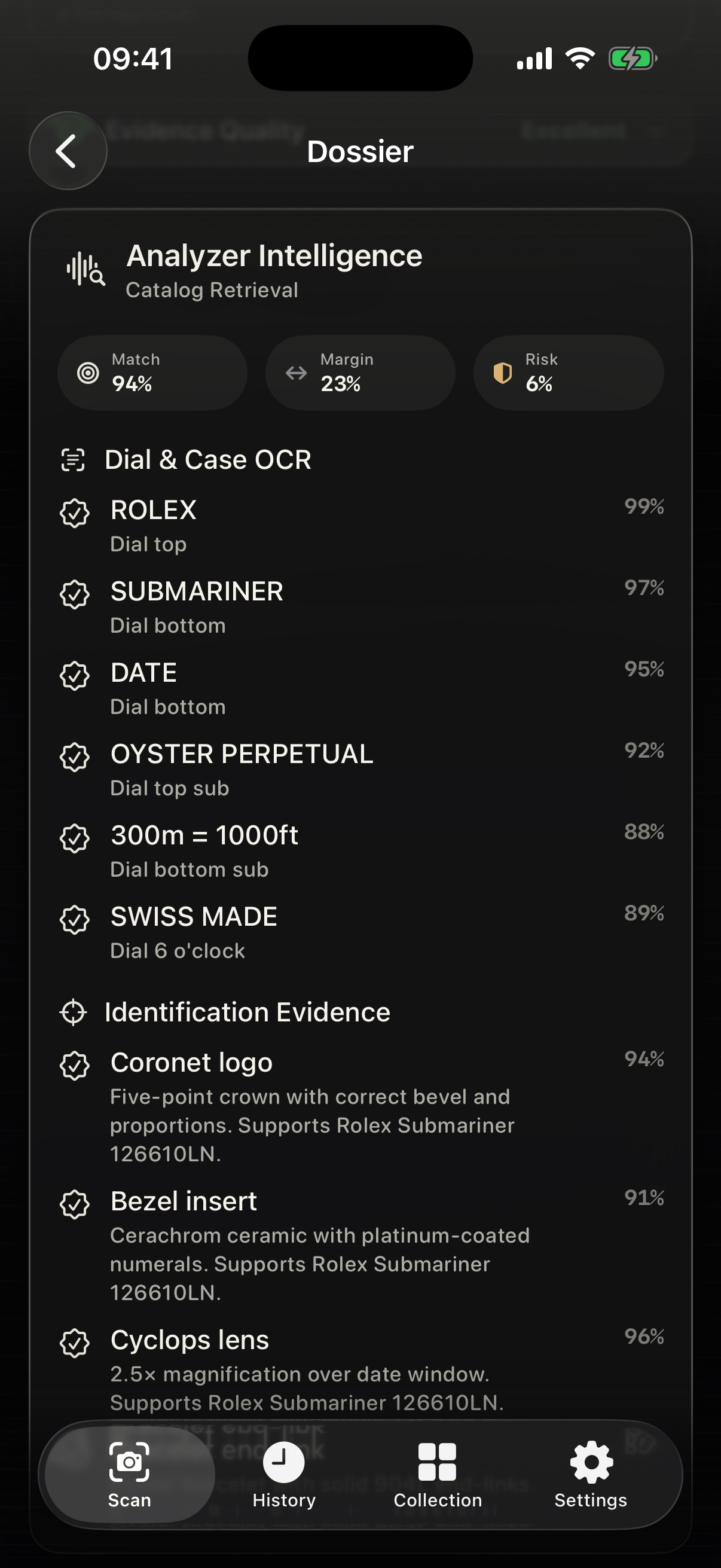
WatchRadar works from guided photos. It suggests the likely brand, model and reference with a confidence level, reads the visible dial and caseback text, and explains which visual signals support or contradict that identity. It then gives a verdict of Likely authentic, Uncertain or High risk with a recommended next step. The photos are uploaded and analysed on WatchRadar’s servers. Three angles are enough to start a scan; the five below give it the strongest evidence.
Dial, square-on, signature sharp
Fill the frame with the dial and hold the phone parallel to the crystal. The IWC / SCHAFFHAUSEN signature, the model name and any registers need to resolve cleanly, because this is the frame where the reference is identified and the dial text is read. Portugieser crystals are domed and reflective, so turn away from windows and overhead lamps until the glare line clears the registers.
Bezel and rehaut, tilted slightly
Tilt about 15 degrees so the bezel and the rehaut (the inner flange) show all the way round. On a Portugieser Chronograph this frame catches the quarter-second scale; on an Ingenieur, the five bezel screws; on an Aquatimer, the outer bezel and the internal dive-time ring together.
Crown side, at case height
Shoot the 3 o’clock flank level with the case. This frame carries the crown shape (the conical crown of a Big Pilot’s Watch, the large crown and piston pushers of a Portugieser Chronograph) and the case thickness, which changes between generations.
Caseback, flat and evenly lit
Lay the watch face-down and shoot the back straight on. On a solid back this frame reads the engravings and the case number; on a display back it shows the calibre marking, the rotor and, on Pellaton movements, the winding system. Keep the case number legible, because you will need it for the paperwork check.
Clasp or buckle, open
Photograph the strap or bracelet laid out, with the folding clasp or pin buckle open. On straps with IWC’s EasX-CHANGE quick-release system, include one strap end. An unsigned or aftermarket buckle does not make a watch fake, but it belongs in the record and in the price conversation.
Other brand guides
- Jaeger-LeCoultre: Reverso and Memovox tells, a Richemont stablemate and the closest comparison for reading a calibre through a display back.
- How to spot a fake Panerai, the other Richemont tool-watch brand with a closed-back, military-heritage story.
- Rolex: cyclops, rehaut and bracelet checks.
- Omega: Speedmaster and Seamaster tells.
- Cartier: Tank, Santos and Ballon Bleu tells.
- Audemars Piguet: Royal Oak tapisserie and screws.
- Patek Philippe: Nautilus and Aquanaut tells.
- How to spot a fake Tudor.
- How to spot a fake Breitling.
- How to spot a fake TAG Heuer.
- How to spot a fake Hublot.
- Start at the brand guide hub for every maker covered.
Reading this before a specific kind of IWC deal?
- Buying a Portugieser or a Pilot’s Watch from a listing: the pre-purchase inspection for buyers lists the photos to ask a seller for.
- Checking IWC stock at volume: the reseller verification workflow.
- Keeping papers, service history and past reports together: the collector’s watch box.
- Not sure which IWC you have? Start with the watch identifier, which suggests the likely model and reference from photos.