Why Breitling is counterfeited, and which models are targeted
Léon Breitling founded the company in Saint-Imier in 1884, and its best-known designs are loud and instantly recognisable: the Navitimer’s crowded slide-rule dial, the Chronomat’s rider-tab bezel, the large cases of the Avenger. That is easy for a counterfeiter to suggest and hard to execute. The models copied most are the Navitimer, the Chronomat, the Superocean and Superocean Heritage, the Avenger, and the Breitling for Bentley chronographs of the 2000s and 2010s.
Breitling also has a quirk that changes how you check one. Since 1999 the brand has committed to COSC chronometer certification for its whole range, quartz as well as mechanical. "Is it a chronometer?" therefore separates nothing on a Breitling, and a ticking seconds hand is not automatically a fake. The checks that work are about whether the dial, calibre, reference code and era agree with each other.
Winged logo or B logo: matching Breitling branding to the era
- Script B, from the mid-century. According to Breitling’s own historian, a script "B" above the BREITLING name started appearing around 1948 and was in general use by 1952. Many early Navitimer dials carry the winged logo of the Aircraft Owners and Pilots Association (AOPA), which adopted the Navitimer as its official watch in 1954.
- Wings and anchor, 1980s to 2018. In the 1980s Breitling added a ship’s anchor passing through a stylised B, with wings on either side. It appears on most Breitlings of that period.
- Script B again, from 2018. Under CEO Georges Kern, Breitling dropped the anchor and wings in 2018 and returned to the script B. A dial from a post-2018 model family, such as the 2020 Chronomat B01 42, carrying the wings and anchor is a mismatch.
- AOPA wings on the current Navitimer. The 2022 redesign, for the model’s 70th anniversary, put the AOPA wings back at 12 o’clock across the standard Navitimer collection. On a 2022-generation Navitimer the wings are correct; on other current families they would be unusual.
What to check on a Breitling: seven brand-specific tells
1. The Navitimer slide rule stays in register
Turning the notched bezel rotates an outer logarithmic scale against a fixed inner one, which is how the Navitimer does flight calculations. Set the two scales so their 10s line up and every other graduation should line up too, all the way round. A misprinted scale cannot hide that. On fakes the bezel may not turn at all, or the scales drift apart.
2. Subdial layout matches the calibre
The in-house B01 puts running seconds at 9, the 30-minute counter at 3 and the 12-hour counter at 6, with the date between 4 and 5. A Valjoux 7750-based Calibre 13 has its minute counter at 12, hour counter at 6 and seconds at 9. A watch sold as a B01 with a 12, 6 and 9 layout does not match.
3. The reference code decodes correctly
Breitling references encode the build. The first letter is the case material (A for steel, E for titanium). The next characters give the movement: 10 to 49 for mechanical calibres, 50 and above for quartz, and B01 or B20 for manufacture calibres. A quartz code on a watch with a sweeping mechanical seconds hand is a mismatch, and so is the reverse.
4. Chronomat rider tabs and Rouleaux links
The Chronomat, launched in 1984, has four rider tabs on its bezel. The 2020 Chronomat B01 42 revived the Rouleaux bracelet: cylindrical brushed links with polished rings on alternating links. Counterfeits often fit loose or glued tabs, and give every link the same finish.
5. Superocean Heritage calibre by generation
The Superocean line dates from 1957. Earlier three-hand Superocean Heritage models use the Calibre 17, based on the ETA 2824-2 or Sellita SW200, and carry an A17 reference. The Superocean Heritage B20 of 2017 uses the B20, derived from Tudor’s MT5612, with an AB20 reference and a 70-hour power reserve. The caseback code and the listing have to tell the same story.
6. Quartz where quartz belongs
Breitling makes genuine thermocompensated SuperQuartz models, such as the Aerospace and other Professional pieces, and they tick once a second. A ticking hand is only a red flag when the dial says automatic, the reference code says mechanical, or the model family has never been made in quartz.
7. What a display back shows
B01 references such as the 2022 Navitimer B01 and the 2020 Chronomat B01 42 have a sapphire caseback. Through it you should see a Breitling-signed rotor and a movement that looks like a B01, not the widely copied Valjoux 7750 layout that most counterfeit chronographs are built on.
Where is the serial number on a Breitling? The caseback and paper trail
- The caseback. Breitling engraves the model reference and an individual serial number on the caseback of most references. The engraving should be deep and sharp-edged; shallow, fuzzy or laser-greyed text is a common counterfeit tell. Photograph the whole caseback so the reference can be decoded as described above.
- The chronometer record. Breitling built its own facility, Breitling Chronométrie, in 2001 to support the all-chronometer policy, and each movement is tested by COSC. Older full sets often include a chronometer certificate or booklet whose number should correspond to the watch. Missing paperwork is common on older pieces and is a value question more than proof of anything.
- The digital passport. Since October 2020 Breitling has issued a blockchain-based digital passport, built with Arianee, for every new watch. It is linked to the digital warranty and can be transferred to a new owner on resale. For a watch sold new after late 2020, ask the seller to transfer it; a seller who cannot needs to explain why.
- Service history. A Breitling service centre invoice that names the serial is strong provenance. Store a photo of it with the watch in your records so it travels with any future sale.
B01, B20, Calibre 13 and Calibre 17: the Breitling movement map
Breitling introduced the in-house B01 in 2009, in the Chronomat. It is a column-wheel chronograph with a vertical clutch, a 70-hour power reserve and COSC certification, and it now powers the Navitimer, Chronomat, Premier and Avenger chronographs.
The B20 automatic is Breitling’s version of Tudor’s MT5612; in the other direction, Tudor’s MT5813 in the Black Bay Chrono is derived from the B01 (see the Tudor guide). Outside the manufacture calibres, the Calibre 13 is based on the Valjoux 7750, the Calibre 17 on the ETA 2824-2 or Sellita SW200, and the Avenger GMT uses the Calibre 32.
Why this matters for spotting fakes: most counterfeit chronographs are built on 7750-type clone movements, and most three-handers on 2824-type clones. On a B01 reference the layout and the display back expose a clone quickly. On a Calibre 13 or 17 watch the genuine layout looks much like the clones, so the dial print, the case, the engraving and a watchmaker’s look inside carry more of the weight. Breitling’s history here is long: in 1969 it co-developed the Calibre 11 automatic chronograph with Heuer, Hamilton-Buren and Dubois-Depraz, the movement behind the Heuer Monaco covered in the TAG Heuer guide.
Breitling references worth knowing before you buy
- Navitimer: the 2022 Navitimer B01 Chronograph in 41, 43 and 46 mm with AOPA wings; AB0121 (Navitimer 01, 43 mm); the vintage Navitimer 806.
- Chronomat: Chronomat B01 42 (AB0134, 2020, Rouleaux bracelet), the earlier Chronomat B01 of 2009, and 1980s Chronomats with rider tabs.
- Superocean Heritage: Calibre 17 models with A17 references; Superocean Heritage B20 in 42 mm (AB2010) and 44 mm (AB2030) from 2017.
- Superocean: the Superocean Automatic line in 42, 44 and 46 mm.
- Avenger: Avenger Automatic GMT 43 (A32397); Calibre 13 Avenger chronographs before 2023; the B01 Avenger chronographs from the 2023 refresh.
- Professional and SuperQuartz: Aerospace and other quartz Professional models, identified by their quartz movement codes.
How to photograph a Breitling for a WatchRadar scan
A scan can start with three useful angles; all five below give stronger evidence. The app checks framing, sharpness and glare on the iPhone while you shoot, then uploads the photos to WatchRadar’s servers for analysis. Breitling dials are busy, so sharpness matters more than usual.
Dial, square-on, subdials and scales legible
Fill the frame with the dial so the subdial numerals, the date and the small slide-rule print resolve. This photo carries the logo generation, the subdial layout that should match the calibre, and on a Navitimer the AOPA wings. Keep the light off-axis; the domed crystal on the 2022 Navitimer throws a bright reflection across the scales if lit from the front.
Bezel, tilted about 15 degrees
Tilt the watch so the full bezel ring is visible. On a Navitimer, take this after setting the scales to line up at 10, so the register of both scales can be read in one image. On a Chronomat this frame shows the four rider tabs; on a Superocean, the dive scale and insert.
Crown and pushers, in profile at case height
Shoot the 3 o’clock side level with the case. The crown, the chronograph pushers and the case flank are read here. On a Chronomat, the pushers and crown should sit cleanly within the case profile rather than looking bolted on.
Caseback, flat and evenly lit
Lay the watch face-down and photograph the caseback straight on. On a solid back this captures the engraved reference and serial for decoding; on a B01 display back it also shows the rotor signature and the visible movement layout.
Clasp open, bracelet or strap flat
Open the clasp and lay the bracelet or strap flat so the clasp signature, the link finishing and any adjustment mechanism are visible. On a Chronomat B01 42, make sure the alternating polished rings of the Rouleaux links are in frame.
What WatchRadar does with a Breitling scan
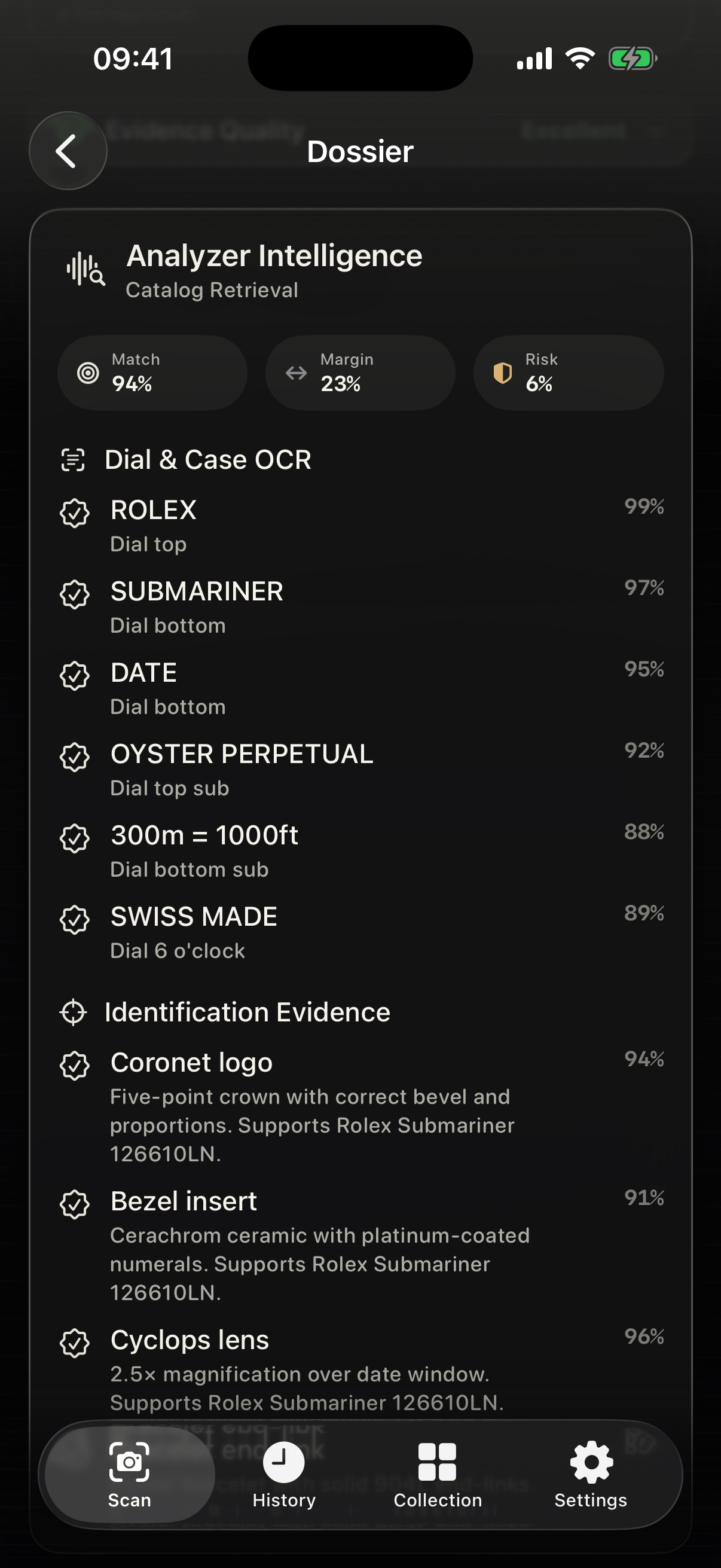
From those photos WatchRadar suggests the likely model and reference with a confidence level, reads the visible dial and caseback text, and explains which signals support that identity and which contradict it, such as a B01 reference paired with a Calibre 13 subdial layout. You get a hedged verdict (Likely authentic, Uncertain or High risk) with the reasons and a recommended next step, plus an estimated secondary-market value range next to the asking price you enter. When the photos do not show enough, the verdict is Uncertain.
A result can be kept in your collection box or shared as an analysis certificate with a WRC ID and a QR code that opens the public verification page. It records the analysis; it is not a legal document.
Other brand guides
- Tudor: Black Bay, Pelagos and the B01 and MT5612 movement exchange.
- TAG Heuer: Carrera, Monaco and the Calibre 11 that Breitling helped develop.
- Omega: Speedmaster and Seamaster chronograph checks.
- Rolex: cyclops, rehaut and bracelet checks.
- IWC: Pilot’s Watch and Portugieser checks.
- Panerai: Luminor and Radiomir checks.
- Hublot: Big Bang checks.
- Cartier, Audemars Piguet, Patek Philippe and Jaeger-LeCoultre.
- Or start at the brand guide hub.
Reading this before a specific kind of Breitling deal?
- Buying a Navitimer or Chronomat from a listing: the pre-purchase walkthrough for buyers lists the photos to ask a seller for.
- Selling or brokering Breitlings: the workflow for resellers.
- Keeping records of what you own: the collection box for collectors.
- Not sure which Breitling you have? Start with the watch identifier.