
Why Panerai is so heavily replicated
Panerai was founded in Florence in 1860 and made its name supplying the Royal Italian Navy: the Radiomir prototype of 1936 was built for navy frogmen, and the crown-protecting device that defines the Luminor was patented in Italy in 1955. The watches reached the civilian market in 1993, and the brand was acquired by the Vendôme group, now Richemont, in 1997. Demand for the big cushion case grew quickly after that, and so did the copies.
Three things make Panerai unusually attractive to counterfeiters. The design is simple: a black dial, large luminous numerals and indexes, and often no more than a small seconds hand. Several genuine references use hand-wound calibres built on the Unitas 6497 base, and cheap clones of that movement are widely available, so a fake can show a plausible-looking movement through a display back. And replica workshops now also imitate the look of Panerai’s own P. calibres. The models you are most likely to meet in copied form are the Luminor Marina and Luminor 1950, followed by the Radiomir and the Submersible.
Because the face tells you so little, a Panerai check leans on consistency more than on any single dial detail. Every modern Panerai carries a reference number, a case code, a serial number, a year letter and a calibre. On a genuine watch they all point at the same thing.
The Panerai numbering system, decoded
| Code | What it identifies | Where it appears |
|---|---|---|
| PAM + five digits (e.g. PAM00111) | The model reference. Often shortened to the last digits, as in “PAM 111”. | Warranty card and paperwork; not normally engraved on the caseback |
| OP + four digits | The case type | Caseback |
| Serial, usually starting BB | The individual case | Caseback, and on the warranty card |
| Year letter + production number (e.g. S 0511/1000) | The production year and the watch’s place in that year’s run of the reference | Caseback |
| OP + Roman numeral (e.g. OP XI) | A movement built on a bought-in base, modified or finished for Panerai | Movement and specifications |
| P. + four digits (e.g. P.9010) | A calibre developed by Panerai, starting with the P.2002 in 2005 | Movement and specifications |
The year letter is the most useful check a buyer can make. Panerai began the sequence with A for 1998, so K is 2008, S is 2016 and Z is 2023, after which the letters doubled up with AA for 2024. The example above, S 0511/1000, is the 511th watch in a run of 1,000 made in 2016. A year letter older than the reference itself, or a letter that contradicts the date on the warranty card, is a warning sign.
Seven tells that give away a fake Panerai
1. The crown-protecting bridge
On a Luminor, a hinged lever inside a bridge locks the crown against its gasket. It should swing smoothly, close flush and press the crown home, and the bridge should meet the case without gaps. On Luminor 1950 cases the lever is engraved REG. T.M.; check that the engraving is crisp and centred. A Radiomir has no bridge at all; the classic Radiomir case uses a large onion-shaped crown instead.
2. Sandwich dial depth
On sandwich-dial references, the numerals and indexes are cut through the top plate and a luminous layer sits on a second plate beneath. Tilt the watch and you should see a clear step with clean cut edges. Lume printed onto a single flat plate, on a reference Panerai built with a sandwich dial, is one of the most common tells. Not every Panerai has one, so check the reference first.
3. The dial layout matches the PAM number
Each reference has one layout. PAM00111 has small seconds at 9 and no date. PAM00312 and PAM01312 add a date at 3. PAM00372 shows hours and minutes only, with no seconds hand at all. A date window, a power-reserve display or an extra hand that the reference does not have points to a fake or to a watch assembled from mismatched parts.
4. The crystal and case fit the reference
Case size and crystal are part of the specification. PAM00372, for example, is a 47 mm Luminor 1950 with a domed Plexiglas front crystal and a sapphire display back, a combination copied from Panerai’s historical watches. Check the listed diameter and crystal for the PAM number in front of you, and treat a mismatch as a question the seller has to answer.
5. Caseback engravings
A modern caseback should carry the OP case code, the serial number and the year letter with its production number, all cleanly engraved and evenly spaced. Panerai does not normally engrave the PAM number on the back, so a caseback that leans on the PAM number instead of these codes deserves questions. Shallow, uneven or smeared engraving is a warning sign on any back.
6. The movement matches the reference
On display-back models, the calibre you can see must be the one Panerai specifies: OP XI in PAM00111, OP X in PAM00210, P.3000 in PAM00372, P.9000 in PAM00312 and P.9010 in PAM01312. A Unitas-based OP calibre is genuine where Panerai specifies it, but a clone of the same base looks similar at a glance, so compare the finishing and markings with a known-genuine example of the same reference.
7. Strap attachment and lugs by generation
Panerai has changed how straps attach over the years: screwed bars on earlier cases, an interchangeable push-pin system with holes in the lugs from around 2006, and tool-free quick-release straps on newer models. Classic Radiomir cases use wire lugs, while the Radiomir 1940 case has solid lugs. An attachment that does not belong to the watch’s generation is worth asking about.
Caseback, serial and warranty: the Panerai paper trail
A Panerai’s paperwork is only as good as its match with the engravings on the watch. Check four things before any money moves.
- Serial match. The serial engraved on the caseback must match the serial on the warranty card, character for character.
- Year letter against the card date. A watch can sit in a shop for a while, so a sale date a little after the production year is normal. A warranty card dated before the year the letter stands for is not.
- PAM number against the watch. The PAM reference on the card must decode to the dial layout, case size, crystal and calibre in front of you.
- Pam.Guard and service history. Panerai’s standard warranty is 24 months. Registering a watch through the QR code on its warranty card within two years of purchase extends it, up to eight years in total, and the extension passes to later owners. Ask whether the watch is registered, and ask for Panerai service receipts, which record the serial.
Box and papers are supporting evidence, not proof. Cards and boxes are counterfeited too. A full set only carries weight when every number on it agrees with the watch.
Panerai models and references to know
- Luminor Marina: PAM00111 (44 mm, hand-wound OP XI, small seconds, no date, sandwich dial, sapphire display back; now discontinued); PAM00312, the Luminor Marina 1950 3 Days Automatic (44 mm, P.9000, date and small seconds); PAM01312, its successor (44 mm, P.9010, three-day power reserve, 300 m).
- Luminor 1950: PAM00372, the Luminor 1950 3 Days (47 mm, hand-wound P.3000, hours and minutes only, Plexiglas front crystal, introduced in 2011). PAM00127 was the first Richemont-era Luminor 1950 in the 47 mm case.
- Submersible: PAM00024, the Luminor Submersible (44 mm, automatic OP III, unidirectional rotating bezel, date at 3).
- Radiomir: PAM00210, the Radiomir Base (45 mm, hand-wound OP X on a Unitas 6497 base, wire lugs, onion crown, sandwich dial).
- Calibre milestones: the P.2002, from 2005, was Panerai’s first in-house movement; the P.3000 and P.9000 families followed, with the P.9010 succeeding the P.9000.
How to photograph a Panerai for a WatchRadar scan
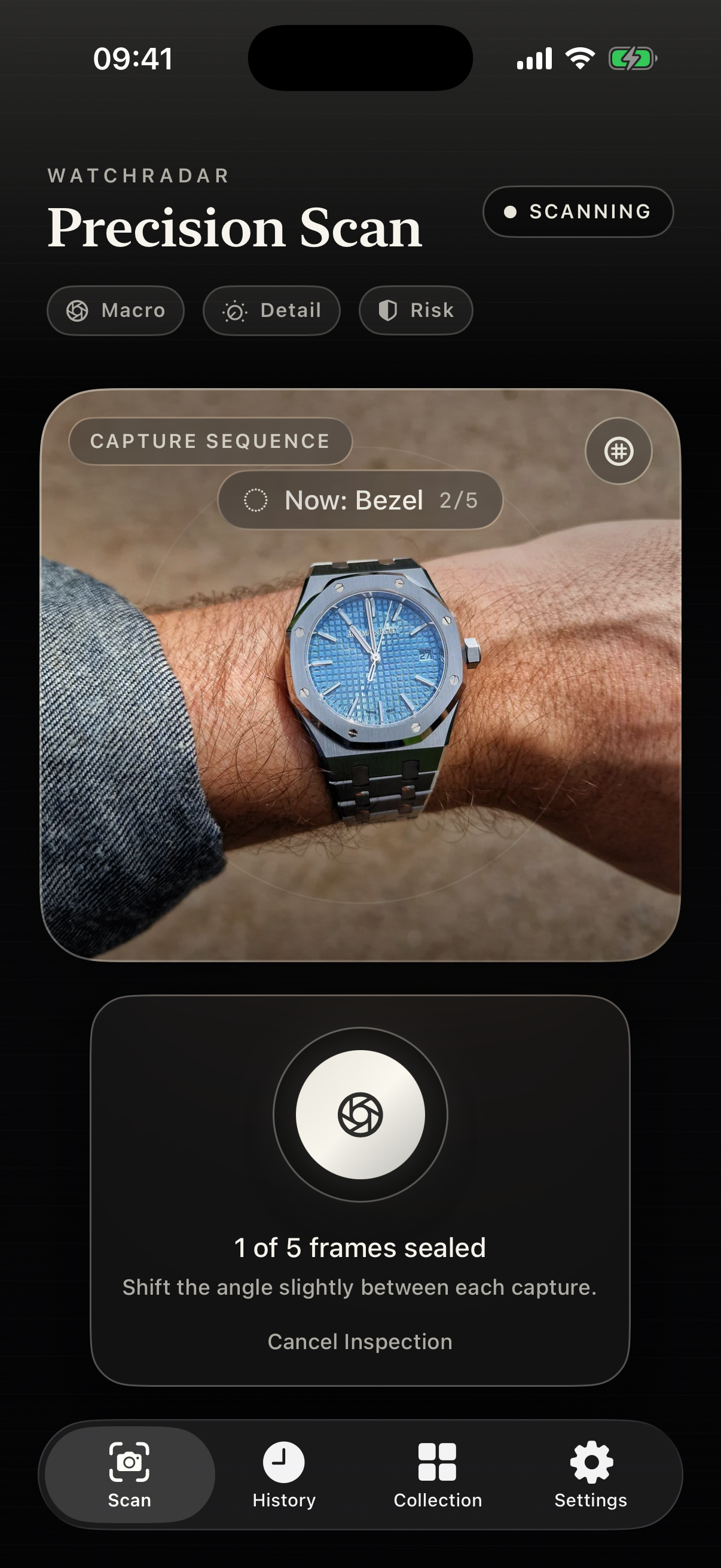
WatchRadar works from guided photos. It suggests the likely brand, model and reference with a confidence level, reads the visible dial and caseback text, and explains which visual signals support or contradict that identity. It then gives a verdict of Likely authentic, Uncertain or High risk with a recommended next step. The photos are uploaded and analysed on WatchRadar’s servers. Three angles are enough to start a scan; the five below give it the strongest evidence.
Dial, square-on
Fill the frame with the dial, phone parallel to the crystal. The Panerai signature, the model name and the numerals need to resolve cleanly. Black sandwich dials swallow detail in dim light, so use soft daylight rather than a lamp, and on a domed Plexiglas crystal turn until the reflection clears the dial text.
Bezel and dial edge, tilted
Tilt about 15 degrees so the bezel and the edge of the dial show all the way round. This is the frame that reveals the step of a sandwich dial and the cut edges of the numerals. On a Submersible, it also captures the rotating bezel scale.
Crown side, level with the case
This is the most important Panerai frame. Shoot the 3 o’clock flank at case height with the lever closed, so the crown-protecting bridge, the lever engraving and the fit against the case are all visible. On a Radiomir, which has no bridge, capture the crown and the lugs from the same angle.
Caseback, flat and evenly lit
Lay the watch face-down and shoot the back straight on, so the OP case code, the serial number and the year letter with its production number are legible. On a display back, make sure the calibre and its markings are in focus too. You will need the serial for the paperwork check.
Strap and buckle
Lay the strap out with the buckle visible, and include one lug so the attachment method (screwed bar, push-pin or quick release) shows. Panerais are often sold on aftermarket straps. That does not make a watch fake, but it belongs in the record and in the price.
Other brand guides
- How to spot a fake IWC, another Richemont tool-watch brand where the caseback and the calibre carry the verdict.
- How to spot a fake Hublot, the other big, heavily replicated case where reference codes do the work.
- Rolex: cyclops, rehaut and bracelet checks.
- Omega: Speedmaster and Seamaster tells.
- Cartier: Tank, Santos and Ballon Bleu tells.
- Audemars Piguet: Royal Oak tapisserie and screws.
- Patek Philippe: Nautilus and Aquanaut tells.
- Jaeger-LeCoultre: Reverso and Memovox tells.
- How to spot a fake Tudor.
- How to spot a fake Breitling.
- How to spot a fake TAG Heuer.
- Start at the brand guide hub for every maker covered.
Reading this before a specific kind of Panerai deal?
- Buying a Luminor from a listing: the pre-purchase inspection for buyers lists the photos to ask a seller for.
- Checking Panerai stock at volume: the reseller verification workflow.
- Keeping warranty cards, service receipts and past reports together: the collector’s watch box.
- Not sure which PAM reference you have? Start with the watch identifier, which suggests the likely model and reference from photos.