
Why Hublot is counterfeited in such volume
Hublot, French for porthole, was founded in 1980 by Carlo Crocco, whose first watch put a gold case on a natural rubber strap. The brand’s modern identity arrived in 2005, when Jean-Claude Biver launched the 44 mm Big Bang, and LVMH bought the company in 2008. Hublot calls its approach the “Art of Fusion”: unusual materials combined in one case.
Several things make that approach attractive to counterfeiters. The designs are loud and recognisable, so a copy sells on sight. The catalogue is enormous, with the same model offered in many case materials, colours and limited editions, which makes it hard for a buyer to know what a correct watch looks like. And several of Hublot’s materials are easy to imitate in photos: titanium and steel, black ceramic and coated steel, King Gold and plated brass can look alike on a screen. Hublot itself presents its e-warranty, introduced in 2020, as a way of identifying replicas, which tells you how seriously the brand takes the problem.
The fakes you are most likely to meet are the Big Bang Unico, especially in black ceramic and King Gold, the Classic Fusion, and the tonneau-shaped Spirit of Big Bang.
How to read a Hublot reference number
Hublot references follow a fixed pattern: three digits, two letters, four digits, two letters. Each block means something, so the number alone tells you what the watch should be made of and what it should look like.
| Block | Example: 411.NX.1170.RX | What it tells you |
|---|---|---|
| Three digits | 411 | Collection and size. 411 is the Big Bang Unico 45, 441 the Big Bang Unico 42, 542 the Classic Fusion 42, 511 the Classic Fusion 45 and 601 the Spirit of Big Bang. |
| Two letters | NX | Case material. NX is titanium, CI and CM black ceramic, OX King Gold and SX steel. |
| Four digits | 1170 | The dial and bezel configuration. |
| Two letters | RX | The strap. RX is rubber. |
Use the reference as a checklist. A watch sold as 411.CI.1170.RX should have a black ceramic case, not a black-coated one. A 542 should measure 42 mm, not 45. When the material, size or dial does not match the code, either the reference is wrong or the watch is.
Eight tells that give away a fake Hublot
1. The H-shaped screws
Big Bang and Classic Fusion bezels are fixed with six H-shaped titanium screws. On the Big Bang they are functional, holding the layered case together. Look for crisp, sharp-edged H recesses and heads that sit flush and evenly finished. Guides disagree on whether the Hs should line up in a set pattern, so do not rely on orientation; machining quality is the better signal.
2. The layered Big Bang case
A Big Bang case is built as a sandwich: the bezel, a layer of black composite resin, and the case middle, with the crown overmoulded in rubber. From the side, each layer should be distinct, evenly thick and tightly fitted, with no glue, gaps or uneven edges. Fakes often simplify this into fewer parts or paint a line where a separate layer should be.
3. The Unico column wheel
The Unico chronograph movement, first shown in 2010, places its column wheel on the dial side. On openworked Big Bang Unico dials it is visible at 6 o’clock. A genuine column wheel turns by one step each time the chronograph is started or stopped. A missing wheel, or a decorative one that stays still, points to a different movement.
4. Sub-dials that match the calibre
Each model has one layout. The Unico is a two-register flyback chronograph. The Spirit of Big Bang, with its El Primero-based HUB4700, has three registers and a date between 4 and 5. The Classic Fusion Titanium 42 uses a self-winding three-hand calibre. Registers that do not turn, or a layout borrowed from another model, are strong warning signs.
5. Materials that behave as described
Titanium is much lighter than steel, so a titanium Big Bang that feels heavy deserves a question. Ceramic is coloured all the way through, so wear at an edge should never reveal a different metal underneath. Hublot’s Magic Gold, developed with EPFL, is an 18-carat gold alloy with ceramic that is far more scratch-resistant than ordinary gold. Plated fakes tend to show brassy wear on edges and clasps.
6. Crown, pushers and dial printing
The rubber around the crown should fit cleanly with no gap or ragged seam, and the pushers should sit square to the case. On the dial, the HUBLOT signature, the applied indexes and the small printing should be crisp and evenly spaced. On openworked dials, look for clean edges where the dial has been cut away.
7. Caseback serial and edition number
Hublot engraves an individual serial number on the caseback, and it must match the warranty. Limited editions also carry their edition number, often on the caseback. Engraving should be sharp and even. A serial that looks laser-etched and shallow, or an edition number on a model that was never a limited edition, is a warning sign.
8. One Click straps
Hublot’s patented One Click system lets the strap be changed without tools, using a spring-loaded button on each strap end. It is fitted to many recent Big Bang references, but not to every case, so check the reference rather than assuming. If a listing claims One Click, each strap end should clip in and release cleanly without a tool.
Serial, warranty and e-warranty: the Hublot paper trail
Hublot has changed its warranty system several times, and each generation gives a buyer something different to check.
- Serial match. The serial engraved on the caseback must match the serial on the warranty, whatever its form. The reference on the paperwork must decode to the watch in front of you.
- E-warranty, for pieces produced since 2020. Hublot images each watch at the factory. The retailer activates the warranty by photographing the watch in Hublot’s app, which recognises it by the microstructure of its materials. Ask the seller how the e-warranty was activated, and whether a Hublot boutique can confirm it for you.
- Earlier warranty cards. Before the e-warranty, Hublot issued warranty cards with a chip; from 2015 they used NFC, were activated by the retailer and could be checked by tapping a phone. A card that cannot be read proves little either way, and a readable one still has to match the caseback.
- Service history. Hublot service receipts record the serial and are harder to fake convincingly than a warranty card. Ask for them on any pre-owned watch.
Box and papers are supporting evidence, not proof. Cards and boxes are counterfeited alongside the watches, so a full set only carries weight when every number on it agrees with the watch.
Hublot models and references to know
- Big Bang Unico 45: 411.NX.1170.RX (titanium), 411.CI.1170.RX (black ceramic, Hublot’s “Black Magic”) and 411.OX.1180.RX (King Gold), all with the in-house HUB1242 flyback chronograph. Its predecessor, the HUB1240 of 2010, was Hublot’s first in-house movement.
- Big Bang Unico 42: 441.NX.1171.RX (titanium), with the HUB1280 Unico 2 calibre introduced in 2018.
- Classic Fusion: 542.NX.1171.RX, the Classic Fusion Titanium 42 (calibre HUB1112 on a Sellita SW300-1 base, six H-shaped titanium screws, sapphire display back, 50 m); 511.NX.1171.LR (titanium, 45 mm); 511.CM.1171.RX (black ceramic, 45 mm).
- Spirit of Big Bang: 601.NX.0173.LR (titanium), introduced in 2014 with a 51 × 45 mm tonneau case and the HUB4700, based on the Zenith El Primero and beating at 36,000 vibrations per hour.
- The original Big Bang: launched in 2005 in a 44 mm case, the model that set the layered construction every later Big Bang builds on.
A sourced base movement is not a sign of a fake. The Classic Fusion’s HUB1112 is built on a Sellita base and the Spirit of Big Bang’s HUB4700 on the El Primero. What matters is that the calibre matches the reference.
How to photograph a Hublot for a WatchRadar scan
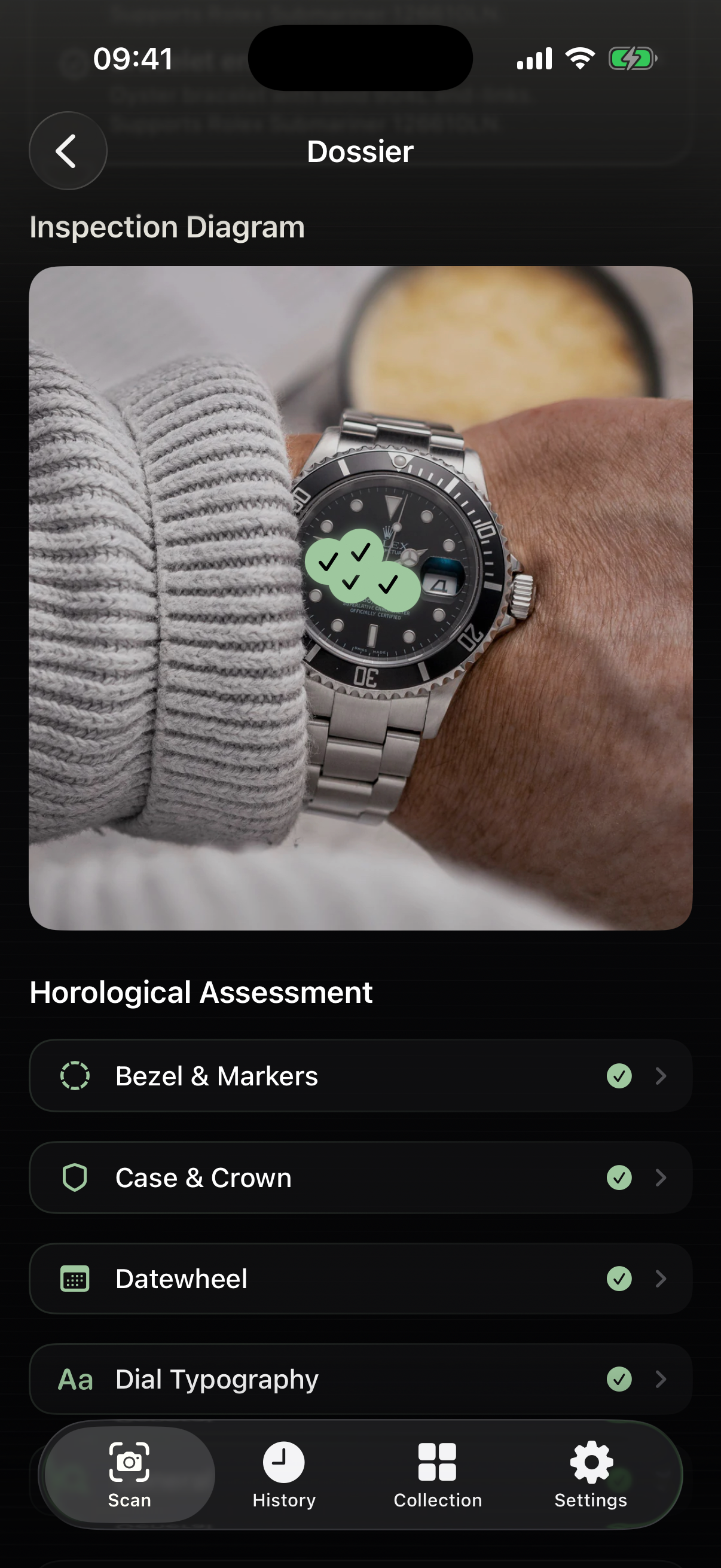
WatchRadar works from guided photos. It suggests the likely brand, model and reference with a confidence level, reads the visible dial and caseback text, and explains which visual signals support or contradict that identity. It then gives a verdict of Likely authentic, Uncertain or High risk with a recommended next step. The photos are uploaded and analysed on WatchRadar’s servers. Three angles are enough to start a scan; the five below give it the strongest evidence.
Dial, square-on
Fill the frame with the dial and hold the phone parallel to the crystal. The HUBLOT signature, the registers and, on openworked Unico dials, the column wheel at 6 o’clock need to be sharp. Skeleton dials show everything behind them, so use a plain, dark background and soft light to keep the layers readable.
Bezel and screws, tilted
Tilt about 15 degrees so all six H-shaped screws and the bezel edge are visible. Keep the screws in focus: their machining and seating are among the most useful details in the whole scan. Polished titanium and ceramic bezels reflect strongly, so turn until no bright spot sits on a screw head.
Crown side, showing the layers
Shoot the 3 o’clock flank at case height. On a Big Bang this frame shows the layered construction, the rubber-overmoulded crown and the chronograph pushers. Make sure each layer of the case is visible and in focus, because this is where simplified fake cases give themselves away.
Caseback, flat and evenly lit
Lay the watch face-down and photograph the back straight on, so the serial number and any edition number are legible. On a display back, keep the movement and its markings in focus too. You will need the serial for the warranty check.
Strap and clasp
Lay the strap out with the deployant clasp or buckle visible, and include one strap end where it meets the case. If the watch has One Click, show the release button. A replacement strap does not make a watch fake, but it belongs in the record and in the price.
Other brand guides
- Audemars Piguet: Royal Oak tapisserie and screws, the other case where bezel screws carry much of the verdict.
- How to spot a fake Panerai, another large, heavily replicated case where reference codes do the work.
- Rolex: cyclops, rehaut and bracelet checks.
- Omega: Speedmaster and Seamaster tells.
- Cartier: Tank, Santos and Ballon Bleu tells.
- Patek Philippe: Nautilus and Aquanaut tells.
- Jaeger-LeCoultre: Reverso and Memovox tells.
- How to spot a fake Tudor.
- How to spot a fake Breitling.
- How to spot a fake TAG Heuer.
- How to spot a fake IWC.
- Start at the brand guide hub for every maker covered.
Reading this before a specific kind of Hublot deal?
- Buying a Big Bang from a listing: the pre-purchase inspection for buyers lists the photos to ask a seller for.
- Checking Hublot stock at volume: the reseller verification workflow.
- Keeping warranty records, service receipts and past reports together: the collector’s watch box.
- Not sure which Hublot reference you have? Start with the watch identifier, which suggests the likely model and reference from photos.