
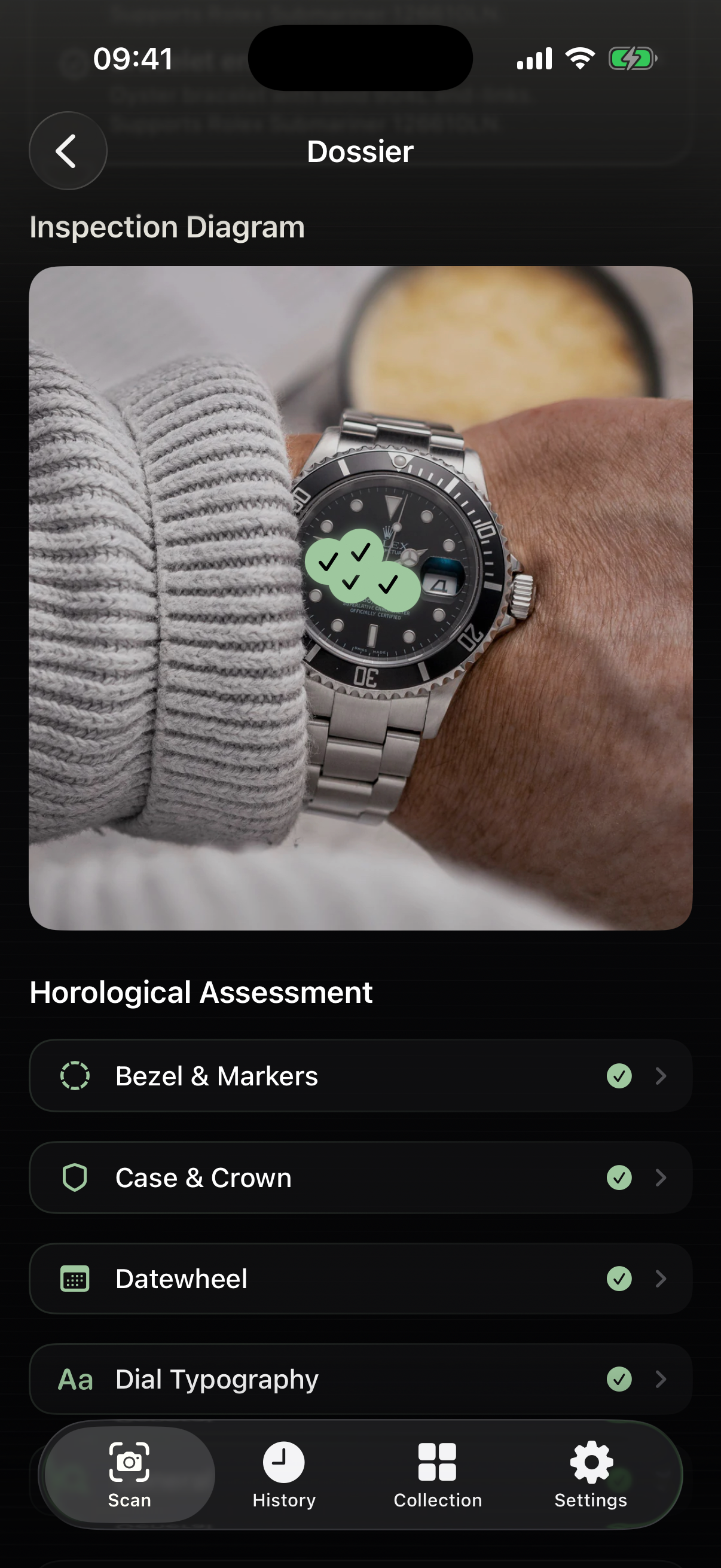
The Cosmograph Daytona is a chronograph first, and that is where most counterfeits give themselves away. Cheap fakes print the subdials; better ones fit a working chronograph but get the layout, bezel or pushers wrong for the reference they claim. Pin down the reference first, because a watch that mixes details from two generations is a warning in itself.
Which Daytona are you looking at?
- 16520 (1988 to 2000). Steel, Zenith-based calibre 4030. Running seconds sit at 9 o’clock on this generation, which matters for the layout check below.
- 116520 (2000 to 2016). Steel with an engraved steel tachymeter bezel. The first Daytona with Rolex’s in-house calibre 4130, a vertical-clutch chronograph with a 72-hour power reserve.
- 116500LN (2016 to 2023). The first steel Daytona with a black Cerachrom (ceramic) bezel, offered with a white or black dial. Calibre 4130.
- 126500LN (2023 onward). Calibre 4131. The ceramic insert is now ringed by a thin polished steel edge, the subdial frames are thinner and set slightly further in, and the hour markers are slimmer.
- Precious-metal references. The yellow-gold 116508 on an Oyster bracelet and the 116518LN on an Oysterflex strap (both calibre 4130), and the platinum 126506 (calibre 4131). The 126506 is the only Daytona with a sapphire display back.
Fake Daytona vs real: the side-by-side
| Detail | Genuine | Common fake |
|---|---|---|
| Chronograph at rest | Seconds subdial at 6 runs; centre hand and the counters at 3 and 9 stay at zero | Centre hand sweeps as a running seconds; counters printed or moving on their own |
| Subdial layout (4130/4131) | 30-minute counter at 3, running seconds at 6, 12-hour counter at 9 | Zenith-era layout on a “116500LN”, or counters unevenly spaced |
| Date | None, on every Daytona | Date window, sometimes with a cyclops |
| Pushers | Screw down onto threaded tubes; locked when closed | Push-only or dummy pushers; chronograph starts while screwed down |
| Bezel (116500LN, 126500LN) | Black Cerachrom, crisp evenly filled scale; steel rim on the 126500LN | Soft or fuzzy numerals, scale rotated off 12, wrong rim for the reference |
| Rehaut | Engraved ROLEX repeat with the serial at 6 on modern pieces | Shallow, printed or misaligned text |
| Crystal | Tiny laser-etched coronet at 6, visible only at an angle | Missing, or plainly visible head-on |
| Caseback | Plain and closed on every steel and gold Daytona | Glass display back on a steel watch, or an engraved back |
Nine tells that give away a fake Daytona
1. The subdials behave like a chronograph
With the chronograph stopped, only the small seconds at 6 o’clock should move. The centre seconds hand sits at 12, and the 30-minute and 12-hour counters sit at zero. Start the chronograph and the centre hand sweeps; stop and reset it and everything snaps back. A centre hand that sweeps all the time, or counters that creep on their own, is a classic fake tell.
2. The layout matches the generation
Every 4130 and 4131 Daytona puts the 30-minute counter at 3, running seconds at 6 and the 12-hour counter at 9. The Zenith-powered 16520 had running seconds at 9. A watch sold as a 116500LN or 126500LN with seconds at 9 is not what it claims to be. The three counters should sit symmetrically.
3. No date, no cyclops
Rolex has never fitted a date to the Cosmograph Daytona. A date window, with or without a cyclops on the crystal, ends the inspection.
4. Screw-down pushers that actually lock
Daytona pushers screw down onto threaded tubes, like the Triplock crown, and that is part of how the watch reaches 100 metres. Screwed down, they should be locked. Unscrewed, the top pusher starts and stops the chronograph and the bottom one resets it. Pushers that work while screwed down, feel gritty on the thread or do not screw at all are wrong.
5. The tachymeter bezel
On the 116500LN and 126500LN the bezel is black Cerachrom with a crisply filled tachymeter scale. The 126500LN adds a thin polished steel rim around the ceramic; the 116500LN’s ceramic runs to the edge. The scale reads 60 exactly at 12 o’clock. Fuzzy numerals, a scale that is rotated a hair off 12, or the wrong rim for the reference are all tells.
6. The rehaut engraving and serial
On modern Daytonas the inner flange between dial and crystal is engraved with a repeating ROLEX, and the serial sits at 6 o’clock. The letters should be evenly spaced, cleanly cut and aligned with the minute track. Shallow, printed or wandering text is a fake tell, and a serial you can find on other listings is a reason to stop.
7. The laser-etched crown at 6
Since the early 2000s Rolex has etched a tiny coronet into the crystal just above the 6 o’clock marker. It is almost invisible head-on and appears only when light rakes across the glass. Fakes either leave it out or etch it so heavily that you can see it from any angle.
8. Dial printing and markers
Rolex dial print is sharp at any magnification. Check the DAYTONA script above the 6 o’clock counter (in red on the white-dial 116500LN), the text under the coronet and the subdial numerals, which are small enough that fakes often blur them. The 126500LN’s slimmer markers and thinner subdial frames should not appear on a watch sold as a 116500LN, and vice versa.
9. A plain, closed caseback
Steel and gold Daytonas have a plain screw-down caseback with no window and no engraving. The platinum 126506 is the only Daytona Rolex has made with a sapphire display back. A steel Daytona showing its movement through the back is a fake; an engraved back needs an explanation.
What photos cannot show on a Daytona
Every tell above is visible from the outside, which is where the best counterfeits put their effort. Three things no photo can settle:
- The movement. On every Daytona except the platinum 126506, the calibre 4130 or 4131 sits behind a closed caseback. Clone chronograph movements now reproduce the correct layout and behaviour, so a working chronograph proves only that something inside works. A watchmaker opening the back can see whether it is a Rolex calibre.
- Water resistance. A genuine Daytona is rated to 100 metres with its crown and pushers screwed down. Only a pressure test tells you whether the seals, the pusher tubes and the case actually hold.
- Weight and material. Photos cannot weigh a watch or tell one steel alloy from another, and better clones are close enough in weight that a scale proves little.
For any Daytona purchase, and certainly before money moves on a watch you have only seen in photos, have a qualified watchmaker open the caseback and pressure-test the case, or take the watch to a Rolex service centre. Check the warranty card against the serial on the rehaut, and treat a mismatch between the card’s date and the reference’s production years as a hard stop. The buyer’s pre-purchase walkthrough covers what to ask a seller before you get that far.
How to photograph a Daytona for a WatchRadar scan
WatchRadar can start with three useful angles; five give it stronger evidence. On a Daytona, these five frames cover every external tell above. Use soft daylight or one lamp placed to the side, and wipe the crystal first.
Dial, straight on, with the chronograph at rest
Square the watch to the camera with the chronograph stopped and reset, so the centre hand is at 12 and both counters are at zero. Fill the frame so the subdial numerals and the DAYTONA script are sharp, with the light off-axis to avoid glare.
Bezel and rehaut, tilted about 20 degrees
Tip the watch away from you until the inner flange comes into view. This frame carries the full tachymeter scale, the rehaut engraving with the serial at 6 and, on a 126500LN, the steel rim around the ceramic. Let light rake across the glass so the etched coronet at 6 can register.
Crown side, in profile, pushers screwed down
Shoot the 3 o’clock side flat-on at case height with both pushers and the crown screwed down. The pusher tubes, the crown and the crown guards should all be in focus.
Caseback, square on
Turn the watch over and photograph the caseback straight on. On anything but a platinum 126506 it should be plain and closed; any window, engraving or sticker belongs in the evidence.
Bracelet and clasp, clasp open
Lay the bracelet flat with the clasp open so the Oysterlock clasp, the Easylink extension and the end-links meeting the case are visible. On an Oysterflex model, photograph the strap and its buckle instead.
From those photos WatchRadar suggests the likely reference with a confidence level, reads the visible dial and caseback text, and returns a hedged verdict (Likely authentic, Uncertain or High risk) with the reasons behind it and a recommended next step. It shows an estimated secondary-market value range next to the asking price you enter. The photos are uploaded and analysed on WatchRadar’s servers. When the photos do not show enough, the answer is Uncertain rather than a guess.
More model guides
- Rolex guide: the brand-wide checks for cyclops, rehaut, coronet and bracelet.
- How to spot a fake Rolex GMT-Master II: bi-colour Cerachrom, the 24-hour hand and the left-handed Sprite.
- How to spot a fake Rolex Submariner: cyclops, rehaut, bezel pearl and bracelet.
- How to spot a fake Omega Speedmaster, another heavily copied chronograph.
- How to spot a fake Patek Philippe Nautilus and a fake Audemars Piguet Royal Oak.
- Not sure which model you have? Start with the watch identifier.