
The GMT-Master II is copied for its bezel. A Pepsi, Batman or Sprite is recognisable from across a room, and counterfeiters know the colours sell the watch. Making a two-colour ceramic insert with a clean colour change is hard, so the bezel is also where many fakes fail. The better ones now get the bezel close, which pushes the inspection onto the hands, the movement’s behaviour and the details that differ between references.
Know the reference before you inspect it
- 116710LN (from 2007). Single-colour black Cerachrom bezel, green 24-hour hand and green GMT-MASTER II text. Calibre 3186 with a 48-hour power reserve. Oyster bracelet.
- 116710BLNR (from 2013). The first steel GMT-Master II with a two-colour blue and black Cerachrom bezel. Calibre 3186, Oyster bracelet.
- 126710BLRO “Pepsi” (from 2018). Blue and red Cerachrom, red 24-hour hand, calibre 3285 with a 70-hour power reserve. Launched on the Jubilee bracelet; Oyster-bracelet versions followed.
- 126710BLNR “Batman” (from 2019). Blue and black Cerachrom, blue 24-hour hand, calibre 3285. Launched on Jubilee, with an Oyster option added later.
- 126720VTNR “Sprite” (from 2022). Green and black Cerachrom, green 24-hour hand, calibre 3285, on Oyster or Jubilee. Left-handed: the crown and the date sit on the 9 o’clock side.
Rolex added a grey and black 126710GRNR in 2024. The same bezel, rehaut and caseback checks apply to it; the reference-specific details below cover the five watches listed above.
Fake GMT-Master II vs real: the side-by-side
| Detail | Genuine | Common fake |
|---|---|---|
| Bezel colour change | One-piece Cerachrom; clean horizontal split at the 6 and 18 positions | Soft, blurred or stepped boundary; shades that look off beside a reference photo |
| Bezel action | Turns both ways in firm one-hour clicks; triangle sits exactly at 12 at rest | Loose or one-way action; triangle a fraction off 12 |
| 24-hour hand | Red on the BLRO, blue on the BLNR, green on the VTNR and 116710LN | Wrong colour for the bezel, or the wrong shape of tip |
| Setting local time | Hour hand jumps in one-hour steps; seconds keep running; date follows | The 24-hour hand is what moves, or the watch stops while setting |
| Cyclops | Strong magnification (Rolex quotes 2.5×), centred over the date | Weak magnification, off-centre lens |
| Sprite (126720VTNR) | Crown, crown guards and date on the left | Green and black bezel with the crown at 3 |
| Bracelet | Solid links and end-links, no rattle; clasp with Easylink extension | Hollow-feeling links, sharp edges, gaps at the lugs |
| Caseback | Plain and closed on every GMT-Master II | Display back or an engraved design |
Nine tells that give away a fake GMT-Master II
1. The bezel colour transition
Rolex makes its two-colour inserts as a single piece of ceramic, and the colours meet in a clean horizontal line at the 6 and 18 hour positions, level with 3 and 9 o’clock. Under a loupe the boundary should be sharp, with no halo, no bleed and no visible seam. A soft gradient, a stepped line or a thin gap between two halves is a strong tell.
2. The shades themselves
Counterfeit inserts often miss the exact shades: reds that drift towards pink or orange, blues that are too pale or too bright. Colour also shifts with light and camera, so compare in daylight against Rolex’s own product photo for the exact reference rather than against another listing. The moulded numerals should be crisply filled and evenly metallic.
3. Bezel action and alignment
The GMT-Master II bezel turns in both directions and clicks in one-hour steps, 24 around the dial. The action is firm, with no play when you press on the edge. At rest the triangle sits exactly at 12 o’clock. A bezel that turns only one way, rattles, or parks slightly off 12 is wrong.
4. The 24-hour hand colour
Each reference pairs its bezel with a specific 24-hour hand: red on the 126710BLRO, blue on the 126710BLNR, green on the 126720VTNR and on the 116710LN. The 116710LN also prints GMT-MASTER II in green. A Pepsi with a green hand, or a Batman with a red one, is either a fake or a watch assembled from parts.
5. The independent jumping hour
On calibres 3285 and 3186, pulling the crown to its first position lets the local hour hand jump forward or back in one-hour steps while the seconds keep running, and the date follows the local hour. Older and cheaper fakes built on generic movements move the 24-hour hand instead, or stop the watch while you set it. Strong clones copy this function, so passing it proves less than failing it.
6. Cyclops and date
Rolex quotes 2.5× magnification for the cyclops, and the date should fill most of the lens. Fakes are commonly weaker, so the date looks only slightly enlarged, and the lens can sit off-centre over the aperture. Check the date font as well: it should be sharp and evenly weighted.
7. The Sprite is left-handed
The 126720VTNR puts the crown, the crown guards and the date on the 9 o’clock side, with the cyclops over a date at 9. It is the only left-handed GMT-Master II Rolex has offered at the time of writing. A green and black “Sprite” with its crown at 3, or a Pepsi or Batman with a left-hand crown, is not a Rolex configuration.
8. Jubilee or Oyster, and how it is built
The 126710BLRO and 126710BLNR launched on the five-piece Jubilee bracelet and were later offered on the Oyster; the 116710 references came on the Oyster. Either way the links are solid, the end-links sit flush against the case and the clasp carries the Easylink comfort extension. A bracelet that rattles or has sharp edges is a tell; a bracelet swap is a question for the seller, not proof.
9. Rehaut, crystal and caseback
Modern GMT-Master II watches carry the engraved ROLEX rehaut with the serial at 6, a tiny laser-etched coronet in the crystal at 6 that shows only at an angle, and a plain closed caseback. A display back, an engraved caseback or a coronet you can see head-on all point to a fake.
What photos cannot show on a GMT-Master II
- The movement. Every GMT-Master II has a closed caseback, so the calibre 3285 or 3186 is out of sight. Clone GMT movements now copy the jumping hour, which is why a watchmaker opening the back is the step that separates a strong clone from a genuine watch.
- Water resistance. The GMT-Master II is rated to 100 metres. Only a pressure test shows whether the case, crown and crystal seals actually hold.
- Weight, alloy and parts history. Photos cannot weigh the watch, identify the steel, or tell you whether a genuine case is wearing an aftermarket bezel insert or dial. Service papers and a watchmaker’s inspection can.
For a high-value purchase, have a qualified watchmaker open the caseback and pressure-test the watch, or take it to a Rolex service centre. Match the warranty card serial to the rehaut, and make sure the card date fits the reference’s production years (a 126710BLRO dated before 2018 cannot be right). The buyer’s walkthrough lists the questions to ask before you meet.
How to photograph a GMT-Master II for a WatchRadar scan
WatchRadar can start with three useful angles; five give it stronger evidence. On a GMT-Master II, these five frames put every external tell in view. Use daylight or one side lamp, and wipe the crystal first.
Dial, straight on, with the 24-hour hand clear
Square the watch to the camera and set the hands so the 24-hour hand is not hidden under the hour or minute hand. The date should sit centred under the cyclops. Keep the light off-axis so the cyclops does not flare.
Full bezel and rehaut, tilted about 20 degrees
Tip the watch away from you so both colour transitions, at 3 and 9 o’clock, are in one frame along with the rehaut engraving and the serial at 6. Let light rake across the glass so the etched coronet can register.
Crown side, in profile
Shoot the crown side flat-on at case height, crown screwed down. On a Sprite that is the 9 o’clock side; on every other GMT-Master II it is the 3 o’clock side.
Caseback, square on
Photograph the caseback straight on. It should be plain and closed; any window or engraving belongs in the evidence.
Bracelet and clasp, clasp open
Lay the Jubilee or Oyster bracelet flat with the clasp open, so the clasp, the Easylink extension and the end-links meeting the case are all visible.
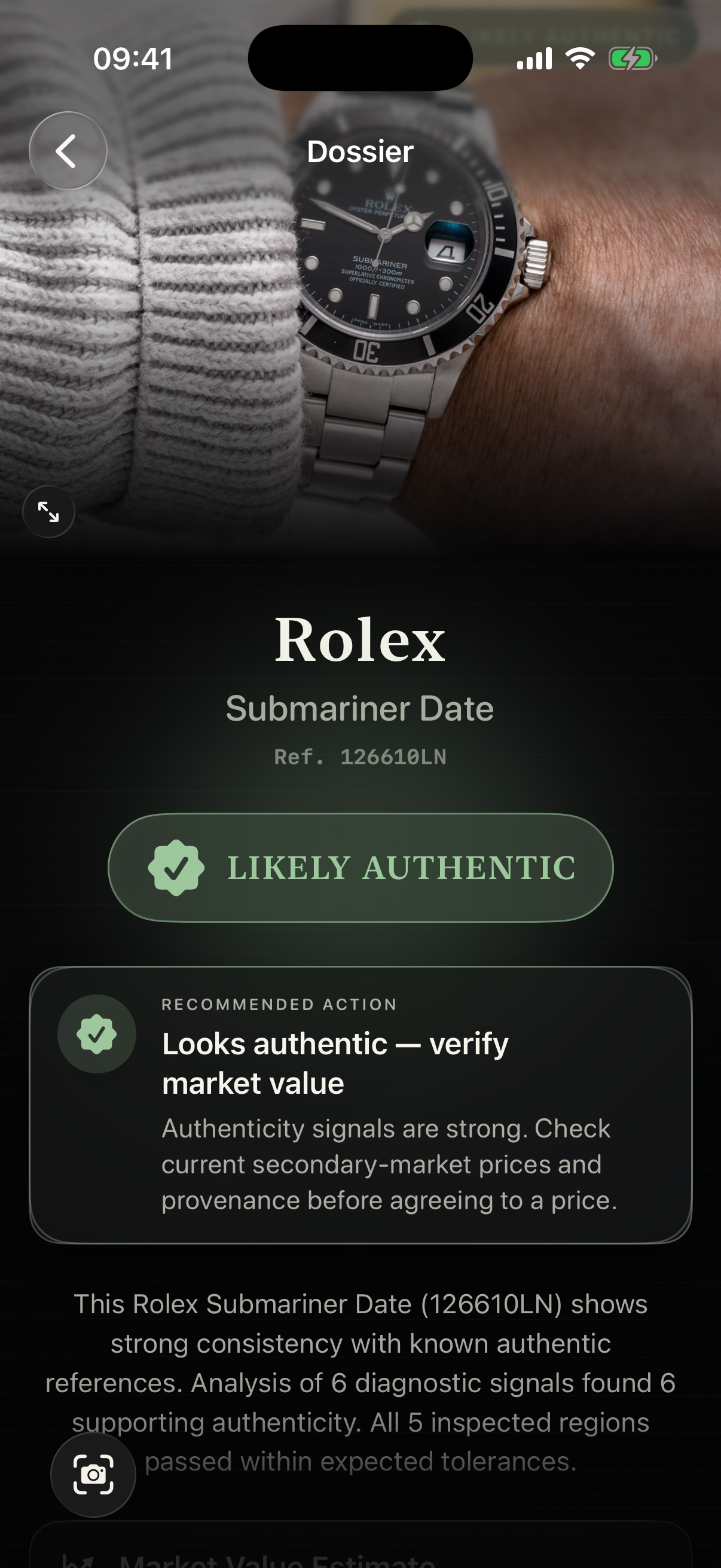
WatchRadar uploads those photos for analysis on its servers, suggests the likely reference with a confidence level, reads the visible dial and caseback text, and returns a hedged verdict (Likely authentic, Uncertain or High risk) with the reasons and a recommended next step, plus an estimated value range next to the asking price. If the photos cannot settle it, the verdict is Uncertain.
More model guides
- Rolex guide: the brand-wide checks for cyclops, rehaut, coronet and bracelet.
- How to spot a fake Rolex Daytona: subdials, pushers and the tachymeter bezel.
- How to spot a fake Rolex Submariner, the GMT’s closest sibling.
- How to spot a fake Omega Speedmaster and a fake Patek Philippe Nautilus.
- How to spot a fake Audemars Piguet Royal Oak.
- Not sure which reference you have? Start with the watch identifier.